Last updated: By Kumar Ashish, German Campus
Short on time? Watch the 2-minute Web Story version of this guide.
The short version: Peaceful protest is legal for you in Germany. But your residence permit makes the stakes much higher for you than for a German classmate. Find your situation in the first table, look at what happened in other countries, and then decide calmly. My personal advice is to use dialogue first.
Many of you have messaged me about the “Gen Z” protests this Saturday. You’ve asked what they are, whether they concern you, and whether you should go. I’ve worked with international students in Germany for more than nine years, and I’ve seen how one emotional afternoon can complicate a visa file for years. That’s why I wrote this guide. I’m not telling you what to think about politics. I want you to decide with the full picture and a cool head.
My stand: what I learned watching Nepal, India, Bangladesh and France
I’ve followed the Gen Z movements in Nepal, India, Bangladesh and now France very closely. Nepal is especially close to my heart because of my family roots. Each time I saw the same pattern: a fair complaint, a fast online mobilisation, then one day when things go out of control. After that, young people pay the price.
- Nepal (September 2025): Young people were angry about a ban on social media and about corruption. Within days, at least 76 people were killed, about half of them shot by police, and the government fell. Many of the dead were the same age as you.
- India, Ladakh (September 2025): For two weeks, local activists led a peaceful hunger strike for statehood and constitutional protections. On 24 September, groups of young people broke away and set fire to a party office. Four people were killed and dozens injured. Two days later, the movement’s leader Sonam Wangchuk, who had been fasting peacefully, was arrested under the National Security Act, and mobile internet was cut in Leh. One violent day took the voice away from weeks of peaceful work.
- Bangladesh (2024): A student movement against job quotas ended with the prime minister fleeing the country. The change came at the cost of hundreds of lives, and the country is still rebuilding.
- France (2026): Pupils had a fair demand: enough teachers. It ended with thousands of minors arrested and young people seriously injured.
So here is my stand, clearly:
- I support young people’s right to be heard. Concerns about education and the cost of living are real, and I share many of them.
- I don’t recommend that international students join street protests when the organisers aren’t transparent and the risk of escalation is real.
- I stand for peace, dialogue and the negotiating table with every democratic party, ministry and university. That is how I’ve worked for over nine years.
- Freedom comes with responsibility. As guests in this country, we’re responsible to our families, our universities, the communities that welcomed us, and the younger students who look up to us. Protecting your future is not cowardice. It is maturity.
1. Who is this guide for? Find yourself in this table
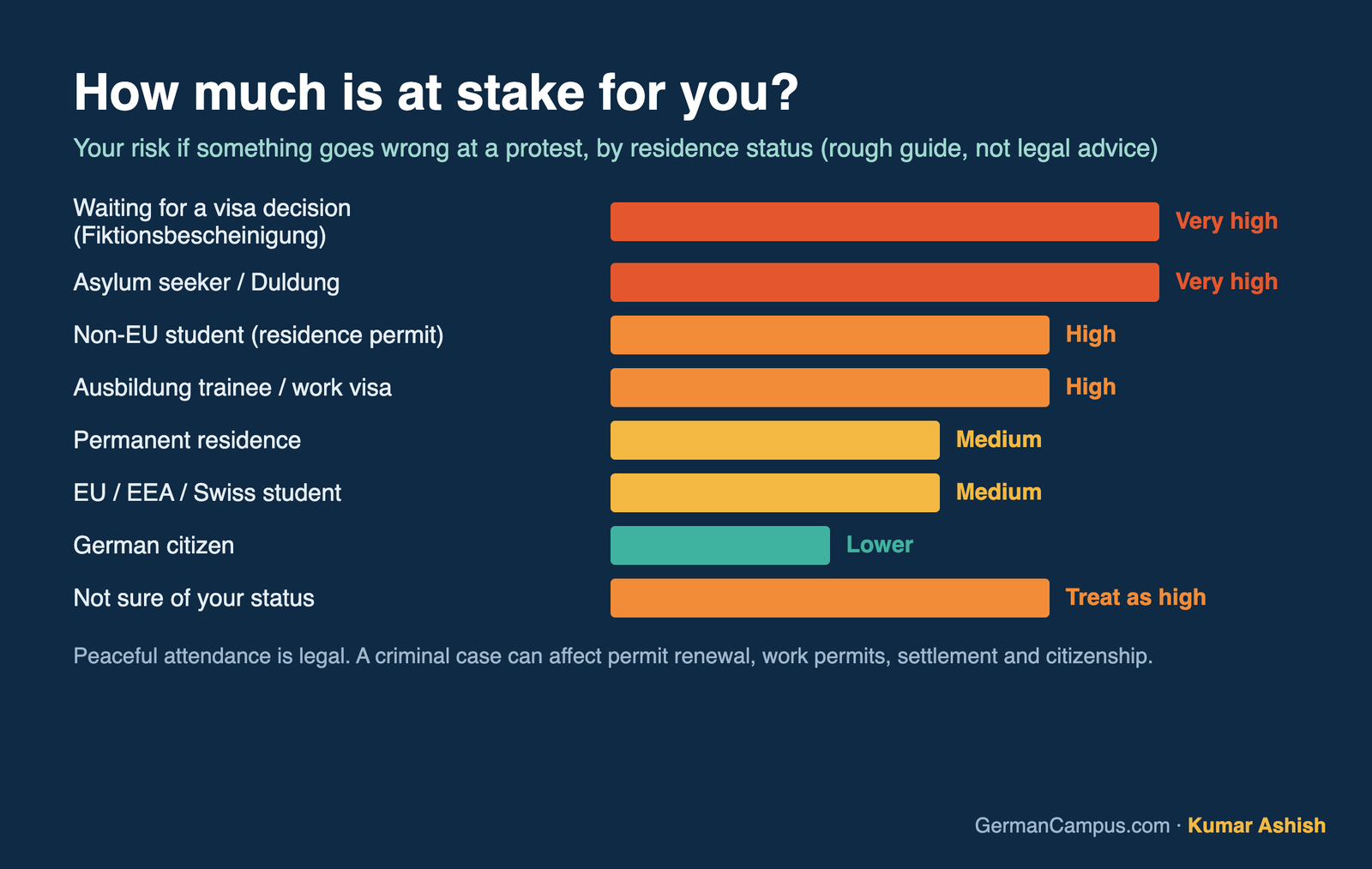
Your risk depends on your residence status. This is a rough guide, not legal advice.
| Your situation | Does this concern you? | Your risk if something goes wrong | My advice |
|---|---|---|---|
| Non-EU student with a student residence permit | Yes, very much | High. A criminal case can delay or block your permit renewal, and later your work permit or settlement permit. | Think twice. If you go, follow the checklist in section 9 strictly. |
| Waiting for a decision (you hold a Fiktionsbescheinigung, or your renewal or change of status is in process) | Yes, very much | Very high. Your file is open on someone’s desk right now. | Better to stay away this time. Use the channels in section 7 instead. |
| Ausbildung trainee or worker on a work visa | Yes | High. Your permit is linked to your contract and employer. | Don’t risk your contract. |
| Asylum seeker, or holding a Duldung | Yes | Very high. | Please don’t go before you’ve talked to a counsellor or lawyer. |
| EU, EEA or Swiss student | Yes | Medium. Your residence is safer, but a criminal record still hurts job applications. | Follow the checklist and stay peaceful. |
| Permanent residence (Niederlassungserlaubnis) | Yes | Medium. Naturalisation (Einbürgerung) checks your record. | Be careful, especially if you plan to apply for citizenship. |
| German citizen (including dual citizens) | Most directly. Topics like conscription apply to you. | Lower residence risk, normal legal risk | Your choice. Stay peaceful and stay safe. |
| Not sure which group you’re in | Probably yes | Unknown. Treat it as high. | Check your residence card, or contact me before Saturday (section 10). |
2. What is happening on Saturday, 31 October
- Who: Two online youth initiatives, “Gen Z regelt” and “Gen Z steht auf”. They are not a political party or an official student union.
- When: Most rallies start around 14:00.
- Where: 21 to 23 cities. The main ones are Berlin, Hamburg, Munich, Frankfurt and Cologne. Others include Leipzig, Dresden, Erfurt, Magdeburg, Stuttgart, Freiburg, Karlsruhe, Ulm and Hannover.
- How many: Organisers report more than 140,000 online sign-ups. Real turnout is usually much lower. Berlin’s main rally at the Brandenburger Tor is registered for 10,000 people.
- Why now: It started as solidarity with school pupils’ protests in France, which later turned violent.
In the north-west:
| City | Plan | What authorities say |
|---|---|---|
| Bremen | 14:00, Marktplatz, about 1,000 online sign-ups | No concrete signs of planned violence. Police will focus on dialogue and de-escalation. |
| Hannover | 14:00, Opernplatz, about 1,900 online sign-ups | Police expect far fewer people and are preparing for different scenarios. |
| Osnabrück, Cuxhaven | Unclear | No clear link to the official Gen Z calls. |
Saturday is also Reformationstag, a public holiday in Bremen and Niedersachsen, and it’s Halloween night. Expect extra police and crowded city centres, especially in the evening.
3. What do they want, and does it concern you?
| Demand | In simple words | Relevant for international students? |
|---|---|---|
| Better schools, no education cuts | Fix run-down schools, hire more teachers | Partly. University funding and student services affect us too. |
| Affordable living | Rent, food and transport are too expensive | Yes, strongly. Rent, blocked-account amounts and Mensa prices hit us directly. |
| Fair share of the burden | Young people shouldn’t pay for budget cuts | Partly. |
| No conscription (Wehrpflicht) | No compulsory military service | Generally no. It applies to German citizens. |
| No more surveillance | Protect privacy and data | Indirectly. |
| Climate action now | Act faster on climate change | Yes, as a global issue, but not specific to us. |
You can agree with some of these and not others. Supporting a cause and joining a particular street protest are two different decisions.
Test your German for freeA1 to C1 in 8 minutes, with your level and a study planStart test →
4. What happened in other countries
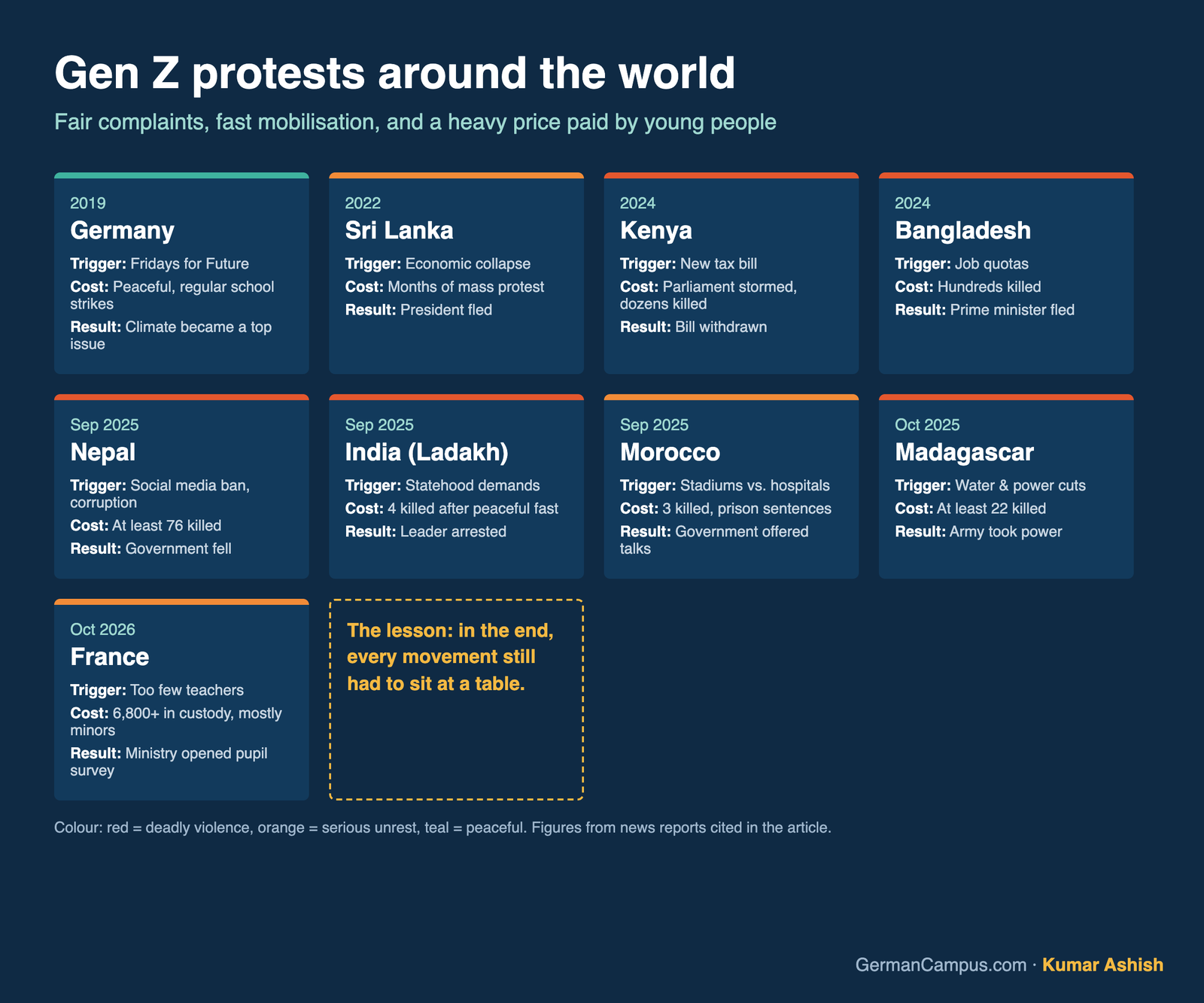
| Country and year | What started it | Human cost | Outcome |
|---|---|---|---|
| Kenya, 2024 | A new tax bill | Dozens killed | Bill withdrawn, but unrest continued |
| Bangladesh, 2024 | Government job quotas | Hundreds killed | Prime minister resigned and fled |
| Sri Lanka, 2022 | Economic collapse | Deaths and injuries | The president fled |
| Nepal, Sept 2025 | Social media ban, corruption | At least 76 killed | Government fell |
| India (Ladakh), Sept 2025 | Statehood and constitutional protections | 4 killed, dozens injured | Leader arrested, internet cut, talks later |
| Morocco, 2025 (“Gen Z 212”) | Stadium spending vs. hospitals and schools | 3 killed; a student sentenced to one year in prison | Prime minister invited the movement to talks |
| Madagascar, 2025 | Water and power cuts | At least 22 killed (UN) | President fled, army took power |
| France, 2026 | Underfunded schools, too few teachers | More than 6,800 in custody, mostly minors; a 17-year-old lost his hand | Ministry opened an online survey for pupils |
| Germany, 2019 (Fridays for Future) | Climate | Practically none | Climate became a top political issue |
What this teaches us:
- Anger spreads faster than plans. Most movements began with fair complaints. Once crowds grew, nobody could control them.
- Infiltrators show up. In several countries, the Gen Z groups themselves said opportunists had hijacked their protests.
- Ordinary young people pay the price, with arrests, records, injuries and lives.
- In the end, there is always a table. Change came through negotiation, elections or new governments. Morocco and France both ended up offering dialogue.
- Germany is different. Fridays for Future stayed peaceful and still shaped the national debate.
France, the model for Saturday: In a single week there were more than 5,000 arrests, and about 85% of those arrested were minors. If French pupils, who are citizens, face this, imagine the consequences for someone whose stay depends on a residence permit.
What people in Germany are saying: The organisers say their protests are peaceful “without exception”. The Bundesschülerkonferenz withdrew its support, citing unclear organisation and the risk of political hijacking. Police in several states warn of radical groups and promise a firm response to violence. Protest researchers expect Germany to stay much calmer than France.
5. A reality check: we are here with a purpose
Let me speak to you honestly, like an elder brother.
We are migrants in this country. Most of us came with one clear goal: to study, build a career and make our families proud. Our days are already full. We have lectures and exams, part-time jobs, rent and contracts, appointments at the Ausländerbehörde, blocked-account paperwork and language classes. Many of our families back home made real sacrifices to send us here.
Social media is designed to make you feel urgent and angry. A TikTok trend fades in a week. A police record can follow your visa file for years. I’ve seen students lose much more than one afternoon because they let their emotions run ahead of them.
Being careful doesn’t mean being silent. It means choosing the smartest way to be heard.
6. My way: dialogue first, the Gandhi way
I personally believe in peaceful, administrative dialogue: sitting at the table with every democratic political party, the ministries and the universities.
Mahatma Gandhi showed the world that peace is a strength, not a weakness. His movement did include marches, such as the Salt March. But it was always strictly non-violent and always paired with negotiation. In 1922, when one protest turned violent, he called off his entire national movement.
I’ve seen this work in Germany too. Working through official channels and patient conversations with politicians, we campaigned to raise the working-day allowance for international students from 120 to 140 days. We also pushed for an extra corona semester, energy-price relief for students and pandemic emergency help (Überbrückungshilfe). None of this needed a street fight. It needed facts, respect and persistence.
Rights have to be asked for nicely, but firmly. In Germany, the door to dialogue is open. Use it.
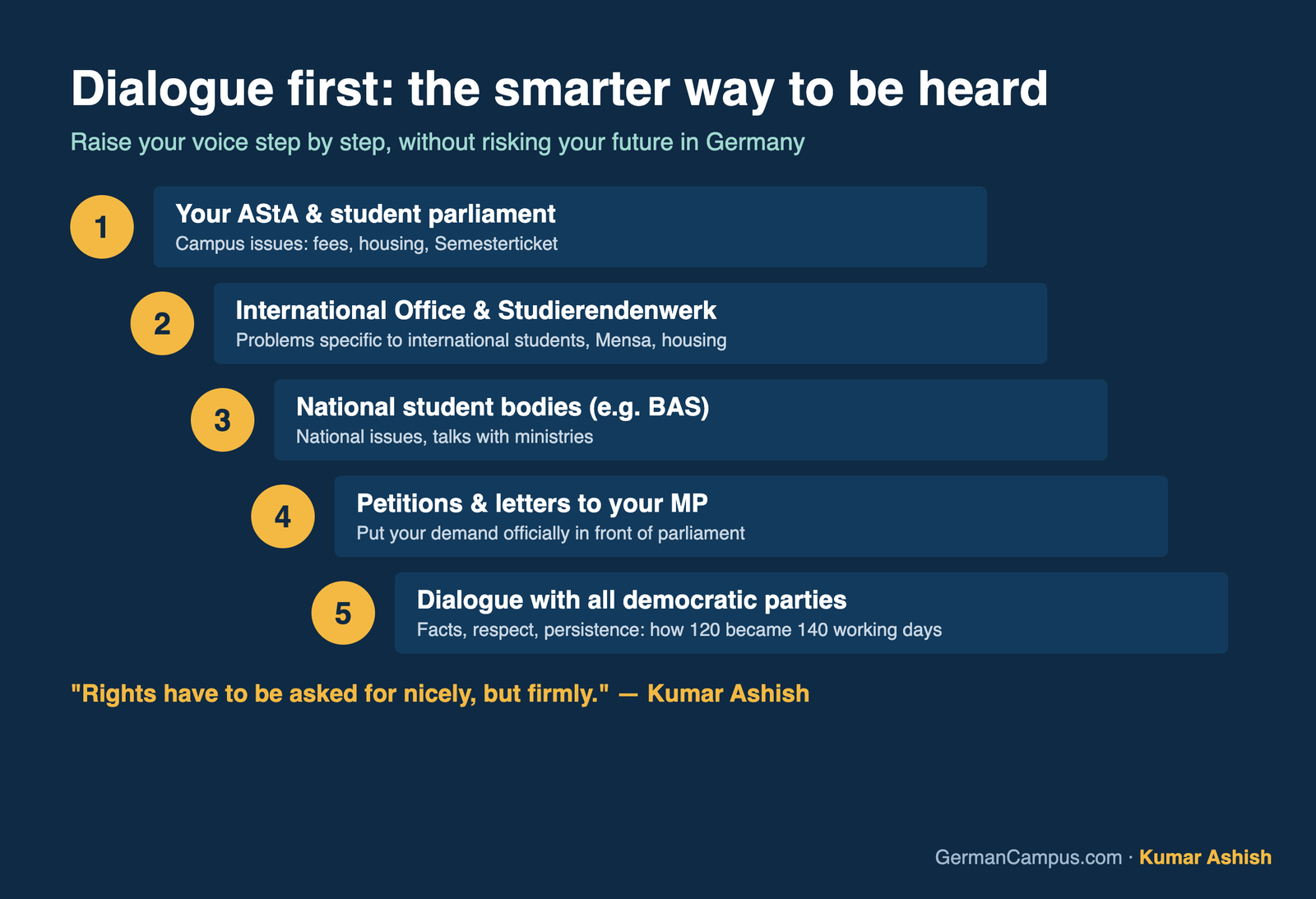
7. Better ways to raise your voice
| Channel | What it’s good for |
|---|---|
| Your AStA and student parliament | Campus issues: fees, services, housing, the Semesterticket |
| Your university’s International Office | Problems specific to international students, and getting them passed upward |
| The Studierendenwerk | Mensa prices, student housing, social counselling |
| National student bodies, such as BAS | National issues for international students, including talks with ministries |
| Petitions (for example, the Bundestag’s e-petitions) | Putting a demand officially in front of parliament |
| A letter or email to your local member of parliament | MPs do read them, especially when they’re short, polite and specific |
| Peaceful events by known student unions | If you want to be visible, choose organisers you can identify and hold accountable |
8. Your rights and your risks, explained simply
- You may join a peaceful, registered demonstration, even as an international student. Peaceful attendance by itself is not a crime and doesn’t harm your visa.
- A criminal case is different. It can affect your permit renewal, a later work permit, permanent residence or citizenship. In serious cases it can lead to an expulsion order. In March 2025, Berlin’s immigration office issued orders to end the residence of four foreign nationals after a university protest, while their criminal cases were still running.
- German law (§ 47 AufenthG) also allows authorities to restrict political activity by foreigners in certain cases.
9. If you still decide to go: my checklist
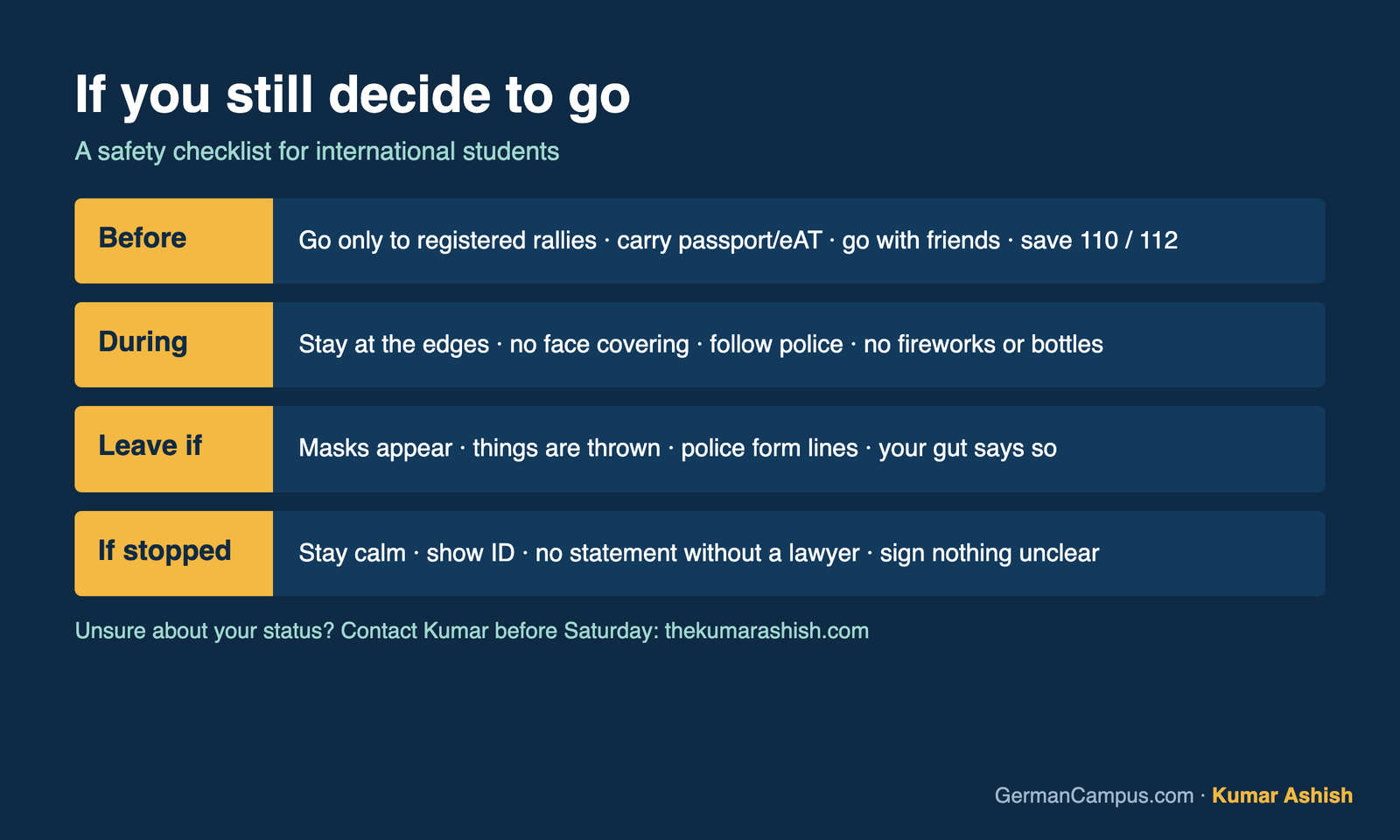
Before you go: Go only to the officially registered rally, and avoid spontaneous evening marches. Carry your passport or residence card (eAT). Go with friends, charge your phone, agree on a meeting point, and save the emergency numbers: Police 110, Emergency 112.
During the protest: Stay at the edges of the crowd. Don’t cover your face to hide your identity, because that’s illegal at assemblies in Germany. Follow police instructions, and if police dissolve the assembly (aufgelöst), leave immediately. Don’t carry fireworks, glass bottles or anything that could count as a weapon. Don’t film other people’s faces up close or post them online.
Leave immediately if people mask up, throw things or damage property, if police form lines or start surrounding the crowd, or if your gut tells you it’s turning.
If police stop you: Stay calm and polite, and show your ID. You don’t have to make a statement about the accusation, so politely ask to speak to a lawyer first. Don’t sign anything you don’t understand, and ask for an interpreter. Contact a lawyer, your AStA legal advice service, or me as soon as possible.
10. Unsure? Need advice? Contact me
If you don’t know which group you belong to, if you’re worried about your visa, or if something happens on Saturday, please reach out before you act. It’s far easier to prevent a problem than to fix one.
- Website: thekumarashish.com
- LinkedIn: linkedin.com/in/thekumarashish
- For legal emergencies: a lawyer or your AStA legal advice service
- For immediate danger: 110 (police) or 112 (emergency)
Your voice matters, but so does your future here. Choose peace, choose dialogue, and look after each other.
Kumar Ashish, Germany’s national student leader with 9+ years of leadership
This guide is general information, not legal advice. Plans can change at short notice, so check your local police and city announcements on the day.
Sources
- Berliner Zeitung: Demos in Berlin on Saturday
- Volksstimme/dpa: The situation in the north-west
- leinetal24: BSK withdraws support
- IamExpat: The demands of Gen Z regelt
- TRT World: 140,000 sign-ups
- Stuttgarter Zeitung: More than 5,000 arrests in France
- Euronews: More than 6,800 in custody in France
- Dazed: 2025, the year of the Gen Z protest
- Al Jazeera: Ladakh activist arrested after deadly protests
- Reuters via Chronicle.lu: Wangchuk arrest and internet cut in Leh
- AllAfrica: Morocco’s Gen Z 212 and the offer of dialogue
- OPB/NPR: Madagascar and Morocco
- Tagesspiegel: Berlin residence orders after a protest
Was this guide helpful?
Thank you! Your feedback helps us keep this guide accurate.