
Last updated: By Kumar Ashish, German Campus
If you live in Hamburg, Leipzig or Hanover, you may have noticed something strange today. It is Saturday, 31 October 2026, yet the supermarkets are closed, the streets are quieter than usual and the buses run on a Sunday timetable. Drive a few hours south to Munich or Stuttgart, and everything is open as normal. Welcome to Reformation Day, or Reformationstag, one of the most interesting public holidays in Germany.
Most international students know that Germany has many holidays, but very few know why a religious event from 1517 still closes shops in nine federal states. In this guide we explain Reformation Day in simple words: what happened, who was involved, why it still matters, how Germans celebrate it today and what it means for your studies, your job and your weekend plans.
Reformation Day at a glance
| Question | Short answer |
|---|---|
| Name | Reformation Day (Reformationstag) |
| Date | Every year on 31 October |
| In 2026 | Saturday, 31 October |
| What it remembers | The start of the Protestant Reformation in 1517, when Martin Luther published his 95 theses in Wittenberg |
| Public holiday in | Brandenburg, Bremen, Hamburg, Lower Saxony, Mecklenburg-Western Pomerania, Saxony, Saxony-Anhalt, Schleswig-Holstein and Thuringia |
| Not a holiday in | Baden-Wuerttemberg, Bavaria, Berlin, Hesse, North Rhine-Westphalia, Rhineland-Palatinate and Saarland |
| Same day abroad | Halloween, which is also celebrated by many young people in Germany |
Reformation Day explained with the 5W1H method
Journalists use six simple questions to explain any event: Who, What, When, Where, Why and How. They work perfectly for Reformation Day.
Who? Martin Luther and the people around him
The central figure is Martin Luther (1483 to 1546), a monk and professor of theology at the young University of Wittenberg. He was born in Eisleben, studied law in Erfurt and, after a dramatic thunderstorm in 1505 in which he feared for his life, promised to become a monk. He kept that promise, entered the Augustinian monastery in Erfurt and later became one of the best-known people in world history.
Luther did not act alone. His colleague Philipp Melanchthon turned his ideas into clear teaching, the painter Lucas Cranach created the famous portraits that made Luther recognisable everywhere, and the ruler of Saxony, Elector Frederick the Wise, protected him from his enemies. On the other side stood Pope Leo X, Emperor Charles V and Archbishop Albrecht of Mainz, whose sale of indulgences started the conflict.
What? A protest that split the Western Church
On 31 October 1517 Luther sent a list of 95 statements, written in Latin, to Archbishop Albrecht. Today we call them the 95 theses. They criticised the sale of indulgences, documents that promised people a shorter punishment for their sins after death in exchange for money. Luther wanted an academic debate and a reform of the Church, not a new church. But his ideas spread so quickly that they started a movement nobody could stop. This movement is called the Reformation, and it led to the Protestant churches that exist all over the world today.
When? 31 October 1517, remembered every year since
The date comes from the letter Luther wrote to Archbishop Albrecht. It is dated “on the eve of All Saints”, which is 31 October. The day was chosen on purpose: on All Saints Day, 1 November, many pilgrims came to Wittenberg to see the large collection of relics in the Castle Church, so Luther knew his topic would get attention. The first big anniversary was celebrated in 1617, and since then Protestants have remembered the date every year.
Where? Wittenberg, a small town that changed the world
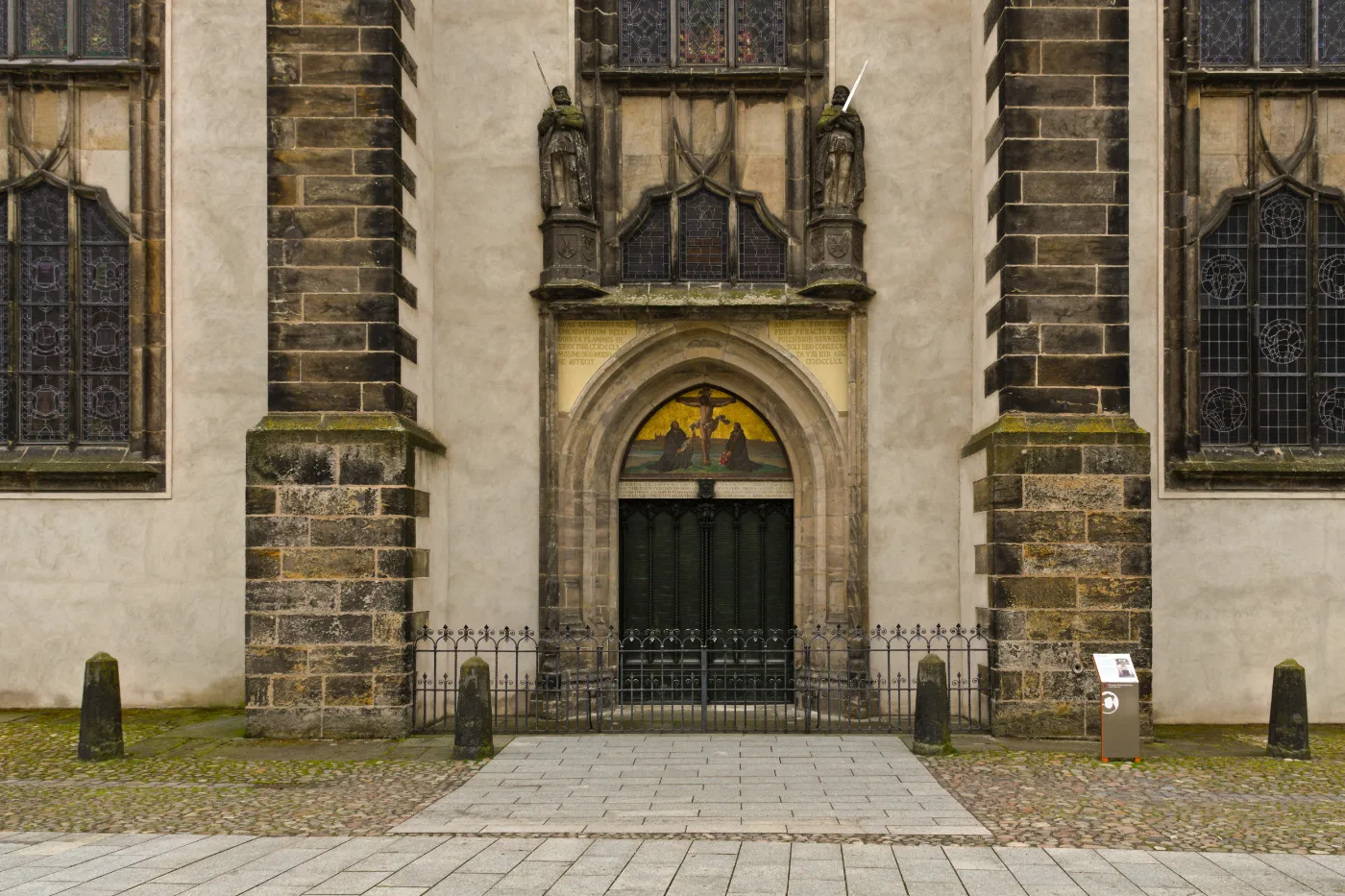
Everything began in Wittenberg in today’s Saxony-Anhalt, about an hour by train from Berlin. Tradition says Luther posted his theses on the door of the Castle Church (Schlosskirche). The town is so proud of this history that its official name is Lutherstadt Wittenberg. From there, the Reformation spread across the German states, to Switzerland, Scandinavia, the Netherlands, Britain and later to every continent.
Why? Money, faith and a new invention
Luther was angry because the Church sold forgiveness. A preacher named Johann Tetzel was selling indulgences near Wittenberg to raise money for the new St Peter’s Basilica in Rome and to help the Archbishop of Mainz repay a large loan. A popular saying from that time sums up the message: “As soon as the coin in the coffer rings, the soul from purgatory springs.” For Luther this was wrong. He believed that people are saved by God’s grace and by faith alone, not by money or good deeds, and that the Bible, not the Pope, is the highest authority for Christians.
Many people were already unhappy with the wealth and power of the Church, and with the taxes that flowed from Germany to Rome. Luther gave this frustration a voice, and the timing was perfect.
How? The printing press made Luther the first media star
About 70 years earlier, Johannes Gutenberg from Mainz had invented printing with movable type. Within weeks, printers in Leipzig, Nuremberg and Basel had copied Luther’s theses, and within months they were known across Germany. Luther then wrote short, punchy pamphlets in German instead of Latin, so ordinary people could read them or have them read aloud. Historians estimate that in the early 1520s a large share of everything printed in German came from Luther. The Reformation was, in a way, the first great media revolution in history.
The story of the Reformation, step by step
The Reformation did not happen in one day. Here are the key moments, from Luther’s birth to the peace that ended more than a century of conflict.
| Year | What happened |
|---|---|
| 1483 | Martin Luther is born on 10 November in Eisleben. |
| 1505 | Caught in a thunderstorm near Erfurt, Luther vows to become a monk and enters the Augustinian monastery. |
| 1512 | He becomes a doctor of theology and a professor at the University of Wittenberg. |
| 1517 | On 31 October he sends his 95 theses against the sale of indulgences to Archbishop Albrecht of Mainz. |
| 1518 | In Augsburg, Cardinal Cajetan asks Luther to take back his ideas. Luther refuses. |
| 1520 | The Pope threatens to excommunicate him. Luther publicly burns the papal document in Wittenberg. |
| 1521 | Luther is excommunicated. At the Diet of Worms he refuses to recant before Emperor Charles V and is declared an outlaw. Friends “kidnap” him and hide him at the Wartburg castle near Eisenach. |
| 1522 | At the Wartburg he translates the New Testament into German in about eleven weeks. It is published in September 1522. |
| 1525 | The Peasants’ War ends in bloodshed. Luther marries Katharina von Bora, a former nun. |
| 1529 | Lutheran princes protest against a decision at the Diet of Speyer. From this “protestation” comes the word Protestant. |
| 1530 | The Augsburg Confession, written mainly by Melanchthon, sets out the Lutheran faith. |
| 1534 | Luther’s complete German Bible is published. |
| 1546 | Luther dies on 18 February in Eisleben, the town where he was born. He is buried in the Castle Church in Wittenberg. |
| 1555 | The Peace of Augsburg allows each ruler to choose the religion of his territory. |
| 1618 to 1648 | The Thirty Years’ War devastates Central Europe. The Peace of Westphalia finally brings lasting religious peace. |
Did Luther really nail the theses to the door?
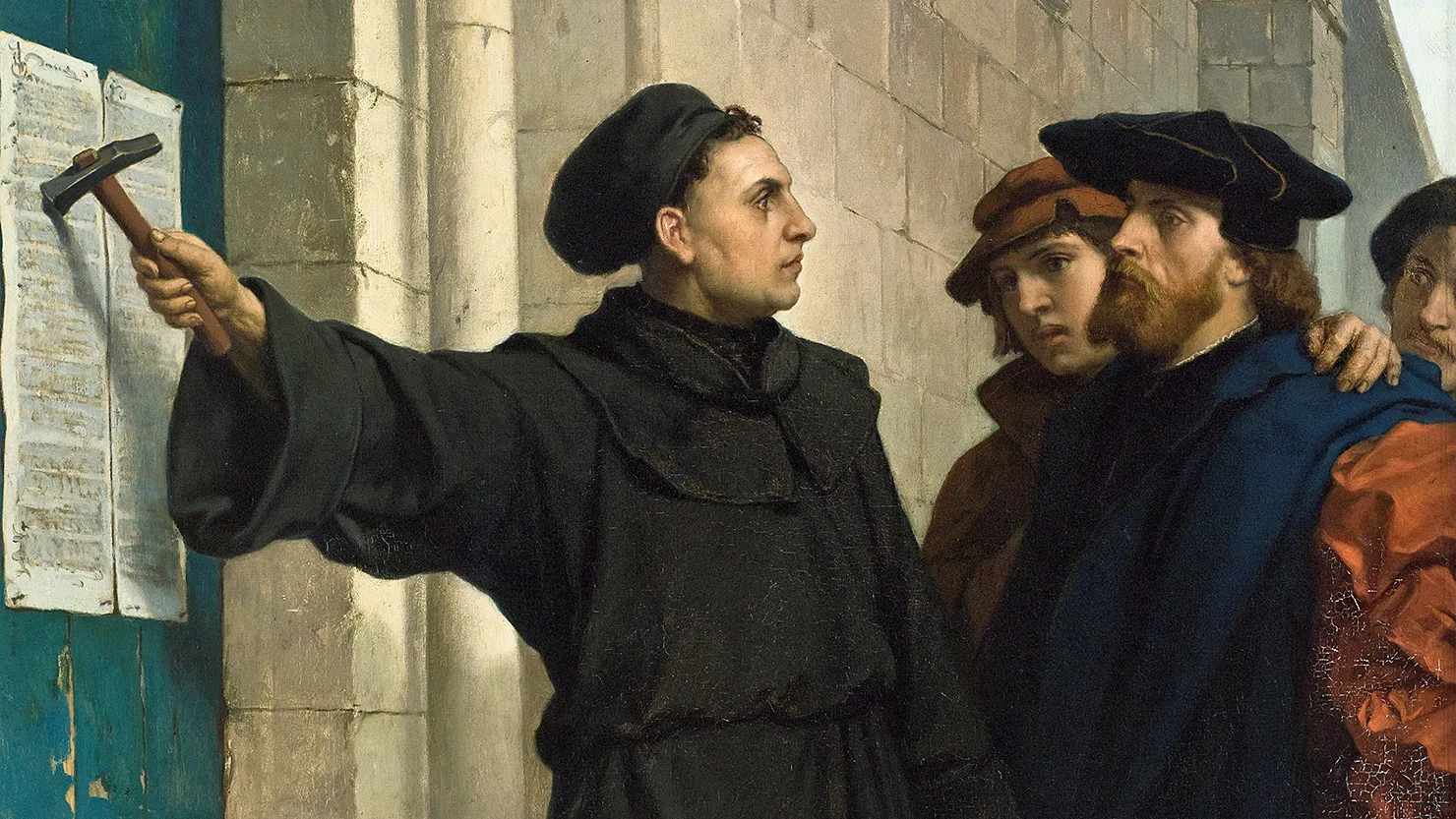
Every German schoolchild knows the image of an angry monk hammering a sheet of paper onto a church door. It is one of the most famous scenes in history, but historians are not sure it ever happened.
Test your German for freeA1 to C1 in 8 minutes, with your level and a study planStart test →
- The letter is certain. Luther’s letter to Archbishop Albrecht, dated 31 October 1517, still exists. The sheet of theses that came with it is lost.
- The posting is uncertain. The story comes mainly from Philipp Melanchthon, who wrote about it after Luther’s death, almost 30 years later. He only arrived in Wittenberg in 1518, so he did not see it himself. A note by Luther’s secretary Georg Rörer, found in 2006, also mentions the posting, but he was not there either.
- Luther himself never mentioned a hammer. In later letters he said he first wrote privately to the bishops and waited for an answer.
- Posting notices was normal. At the university, the church doors served as a noticeboard. If the theses were posted, it was probably an ordinary act, perhaps done with paste by a university employee, not a dramatic protest.
So the honest answer is: Luther definitely wrote and sent the theses on 31 October 1517, and that is what started the Reformation. Whether he nailed them to a door that day remains an open question. The famous painting near the top of this article was made in 1872, more than 350 years later.
What were indulgences? A simple explanation
In the medieval Catholic Church, people believed that after confessing their sins and being forgiven, they still had to “pay” a punishment, either on earth or in purgatory after death. An indulgence was a document from the Church that reduced this punishment. Originally it was linked to prayers, pilgrimages or good works. Over time, it became possible to simply buy one, even for relatives who had already died. Luther’s first thesis says that the whole life of a Christian should be one of repentance, meaning a real change of heart. A piece of paper, he argued, could not replace that.
How the Reformation shaped modern Germany
Even if you are not religious at all, the Reformation affects your daily life in Germany in ways you might not expect.
The German language
Before Luther, there was no single standard German. People in Hamburg, Cologne and Vienna spoke very different dialects. Luther wanted every German to understand his Bible, so he chose words that people across many regions could follow. His translation became a bestseller and helped create the written Hochdeutsch (Standard German) that you learn in your language course today. Expressions such as Lückenbüßer (stopgap) and Feuereifer (great enthusiasm) are often traced back to him.
Education for everyone
If everyone should read the Bible, everyone has to learn to read. Luther asked cities to open schools for boys and girls, which was a radical idea at the time. Protestant regions became leaders in literacy, and the idea of public education for all children grew from there.
Politics and the map of Germany
Because each ruler could choose the religion of his territory after 1555, Germany became a patchwork of Protestant and Catholic regions. You can still see this today: the north and east are traditionally Protestant, while Bavaria, Baden-Wuerttemberg and the Rhineland are traditionally Catholic. This is exactly why Reformation Day is a holiday in the north and east, while All Saints Day on 1 November is a holiday in the Catholic south and west. Many historians also see Germany’s strong federal system, where the states have a lot of power, as partly rooted in this history.
Music and culture
Luther loved music and wrote hymns in German so that the whole congregation could sing, not only the choir. His hymn Ein feste Burg ist unser Gott (“A Mighty Fortress Is Our God”) is still sung today. Two centuries later, Johann Sebastian Bach, a Lutheran church musician, wrote a cantata for Reformation Day based on it.
Work and daily life
Luther taught that every honest job, not just the work of priests and monks, is a calling from God. The sociologist Max Weber later argued that Protestant ideas about work and discipline helped shape modern capitalism. His theory is still debated, but you may recognise some of these values in German work culture, from punctuality to the importance of a job well done.
How 31 October became a public holiday
- 1617: Protestant territories celebrate the 100th anniversary of the theses with great festivities. This makes 31 October the official date of remembrance.
- 1667: The Elector of Saxony makes Reformation Day a fixed annual festival. Other Protestant territories follow.
- 1990s: After German reunification, the eastern states of Brandenburg, Mecklenburg-Western Pomerania, Saxony, Saxony-Anhalt and Thuringia keep 31 October as a public holiday.
- 2017: For the 500th anniversary of the Reformation, 31 October is a public holiday in all of Germany, for one year only.
- 2018: Hamburg, Bremen, Lower Saxony and Schleswig-Holstein make Reformation Day a permanent holiday. Officially, they wanted to close the gap with southern states, which have more public holidays.
The darker side of Luther
An honest article about Reformation Day must also talk about the difficult parts of Luther’s legacy. During the Peasants’ War of 1525, Luther wrote a harsh pamphlet calling on princes to crush the rebelling peasants, and thousands died. In his later years he wrote violently antisemitic texts, such as On the Jews and Their Lies (1543). Centuries later, the Nazis used these writings for their propaganda.
Today the Protestant Church in Germany openly confronts this history. In 2015 the synod of the Evangelical Church in Germany (EKD) formally distanced itself from Luther’s anti-Jewish writings, and many Reformation Day events now include this topic. Luther is remembered as a man who changed the world, but not as a flawless hero.
Reformation Day today: how Germany celebrates
For most Germans, Reformation Day is simply a welcome day off. Still, the day has kept its meaning for many people, and you will find plenty going on if you look for it.
- Church services and concerts: Protestant churches hold festive services, often with Bach’s music or Luther’s hymns. Many organise concerts, lectures and guided tours.
- Wittenberg: The town celebrates with services in the Castle Church and the Town Church, markets and historical events.
- Reformation buns: In Saxony and other parts of eastern Germany, bakeries sell Reformationsbrötchen, sweet buns with jam in the middle. Their shape recalls the Luther rose, the reformer’s personal emblem.
- ChurchNight and Halloween: Because Halloween falls on the same evening, many young people go to costume parties. Some Protestant youth groups organise a “ChurchNight” as an alternative, with music, games and talks.
- A quiet day: In the nine holiday states, shops are closed and life slows down, much like a Sunday.
Religion in Germany in numbers
Germany has changed a lot since 1517. At the end of 2025, about 17.4 million people belonged to the Protestant churches of the EKD and about 19.2 million to the Catholic Church, according to figures published by both churches in March 2026. Together that is around 36.6 million people, or roughly 44 percent of the population. For the first time in centuries, Christians who belong to one of the two big churches are a minority, and both churches lose several hundred thousand members every year. Germany is also home to millions of Muslims, Orthodox Christians, Jews, Hindus, Buddhists and people of many other faiths, as well as a growing number of people with no religion at all.
From enemies to partners
For centuries, Catholics and Protestants in Germany distrusted each other. Today they work closely together. On Reformation Day 1999, the Catholic Church and the Lutheran World Federation signed a joint declaration in Augsburg, agreeing on the very question that had divided them in Luther’s time: how people are saved. On 31 October 2016, Pope Francis travelled to Lund in Sweden to mark the start of the 500th anniversary together with Lutheran leaders. Many Reformation Day events in Germany are now celebrated by both churches together.
What Reformation Day means for you as a student or worker
If you are new to Germany, here is the practical part. Public holidays are decided by each federal state, so what matters is the state where you study or work, not where you live.
| Situation | What to expect |
|---|---|
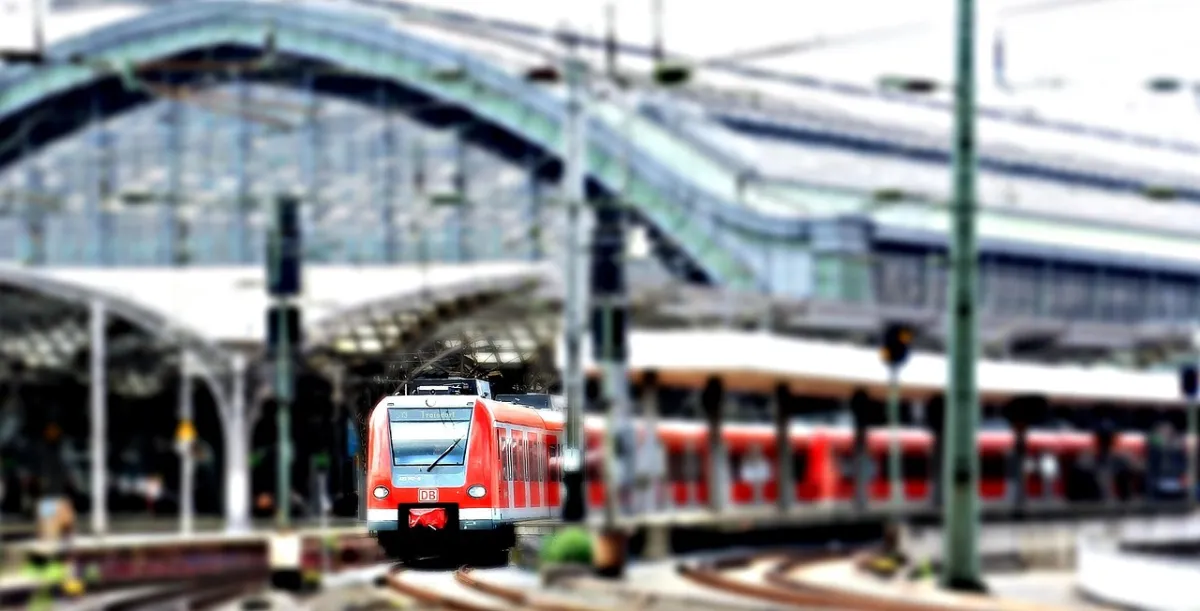
| Shopping | In the nine holiday states, supermarkets and most shops are closed. Shops at large train stations, airports and some petrol stations stay open. In 2026 the holiday falls on a Saturday, so do your weekend shopping on Friday. |
| Public transport | Buses and trams usually run on a Sunday or holiday timetable. Long-distance trains run normally. |
| University | There are no lectures or exams in holiday states. Libraries are often closed or have shorter opening hours, so check before you go. |
| Your job | If the holiday falls on a day you would normally work, you get paid without working. In 2026 this mainly affects people who work on Saturdays. |
| Working on the holiday | Shops and offices are closed, but hospitals, hotels, restaurants and delivery services keep working. Many employers pay a holiday bonus, but this depends on your contract or collective agreement. Holiday bonuses of up to 125 percent of your base pay can be tax-free. |
| Living in Berlin, working in Brandenburg | The holiday rules of the state where you work apply. Berlin has no holiday on 31 October, but Brandenburg does. |
Other holidays in this season: All Saints Day on 1 November is a holiday in Baden-Wuerttemberg, Bavaria, North Rhine-Westphalia, Rhineland-Palatinate and Saarland (in 2026 it is a Sunday). Saxony also celebrates the Day of Repentance and Prayer (Buß- und Bettag), which falls on Wednesday, 18 November 2026.
If you have a student job, read our guide on how many hours international students may work and check your pay with the net salary calculator.
Places to visit if you want to follow Luther’s footsteps
Many of the most important places are in central and eastern Germany and easy to reach with the Deutschlandticket on regional trains. They make a great day trip, especially for history lovers.
- Lutherstadt Wittenberg: The Castle Church with the Theses Door and Luther’s grave, the Lutherhaus (once Luther’s home and today the world’s largest museum about the Reformation) and the Town Church where Luther preached. The Luther sites in Wittenberg and Eisleben are a UNESCO World Heritage Site.
- Wartburg castle, Eisenach: The castle where Luther hid in 1521 and 1522 and translated the New Testament. You can visit the simple room where he worked. The Wartburg is also a UNESCO World Heritage Site.
- Lutherstadt Eisleben: The houses where Luther was born and where he died.
- Erfurt: The Augustinian monastery where Luther lived as a young monk, in a beautiful old town that is also a university city.
- Worms: The Luther monument, one of the largest Reformation memorials in the world, and the place where Luther stood before the emperor.
- Augsburg: The city of the Augsburg Confession and the Peace of Augsburg, and home of the Fuggers, the bankers whose loan played a role in the indulgence trade.
Five surprising facts about Reformation Day
- The 95 theses were written in Latin, the language of scholars. Most ordinary Germans could only read them after they were translated and printed.
- Luther was a skilled writer of everyday German and is credited with popularising many expressions still used today.
- The original wooden door of the Castle Church burned in 1760. The bronze door you see today, with the full Latin text of the theses, was installed in 1858.
- In 2017, the 500th anniversary, Reformation Day was a public holiday in all 16 federal states for the first and so far only time.
- In many other countries, including Chile and Slovenia, 31 October is also marked as Reformation Day, and Protestant churches around the world celebrate it on or around this date.
Frequently asked questions
Is Reformation Day a public holiday in all of Germany?
No. It is a public holiday in nine federal states: Brandenburg, Bremen, Hamburg, Lower Saxony, Mecklenburg-Western Pomerania, Saxony, Saxony-Anhalt, Schleswig-Holstein and Thuringia. It was a nationwide holiday only once, in 2017.
Is Reformation Day a holiday in Berlin?
No. Berlin does not celebrate Reformation Day as a public holiday. Instead, Berlin introduced International Women’s Day on 8 March as an extra holiday in 2019.
Are shops open on Reformation Day?
In the nine holiday states, most shops are closed, just like on a Sunday. In the other seven states, shops are open as usual.
Do I have to be religious to celebrate it?
Not at all. For most people in Germany it is simply a day off. But knowing the story helps you understand German history, language and culture much better.
Is Reformation Day the same as Halloween?
No, but they fall on the same date. Halloween comes from Celtic and Anglo-American traditions and has become popular in Germany, mainly among children and young people. Reformation Day is a Protestant remembrance day. Many people in Germany now celebrate a bit of both.
What is the difference between Protestant and Catholic?
Very simply: Protestants follow the churches that came from the Reformation and see the Bible as the highest authority. Catholics follow the Pope in Rome and also give great weight to Church tradition. Today the two churches cooperate closely in Germany.
Final thoughts
Reformation Day began with a single letter from a monk in a small town in Saxony. Five hundred years later, that letter still shapes the language you are learning, the map of Germany’s holidays and the way many Germans think about work, education and freedom of conscience. Whether you spend today in a church, at a Halloween party, on a trip to Wittenberg or simply enjoying a quiet weekend, you now know the story behind the closed shop doors.
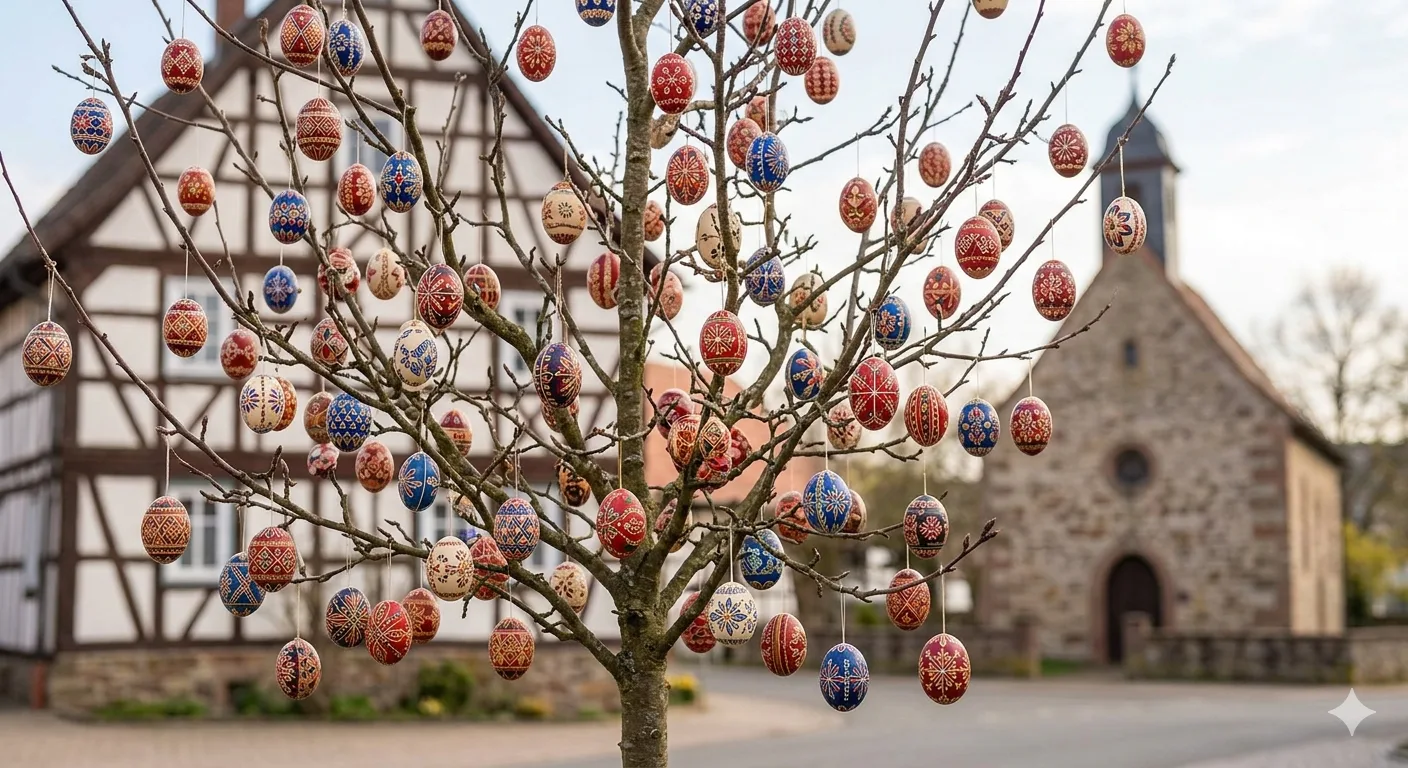
Want to learn more about German traditions? Read our guide to Easter in Germany, discover the most common culture shocks for international students and find more articles in our Special Days section.
Sources: membership figures from the EKD and the German Bishops’ Conference as reported by evangelisch.de (March 2026); historical debate on the posting of the theses as summarised by Spektrum der Wissenschaft; holiday states as listed by Sonntagsblatt.
Was this guide helpful?
Thank you! Your feedback helps us keep this guide accurate.