
Last updated: By Kumar Ashish, German Campus
Welcome to GC University News for May 2026. A worldwide hack hit a learning platform used by thousands of universities, the DAAD presented fresh numbers on international students, and plans to end DAAD partnerships with the Global South caused alarm. Also this month: new research on why studying in Germany is the best route into a German job, a closed main building at TU Berlin, and new doubts about the BAföG reform.
📋 In this issue
- 🔐 Hackers attack the Canvas learning platform
- 📊 DAAD annual report: about 400,000 international students
- 🌍 DAAD fears the end of its partnerships with the Global South
- 💼 Studying in Germany is the fastest route into a German job
- 🏛️ Baden-Württemberg wants to review tuition fees for international students
- 🏚️ TU Berlin has to close its main building
- 💶 BAföG reform in doubt again
- 🧾 New draft law: longer first contracts for PhD candidates
- 🏅 Seven top researchers move to Germany with Humboldt Professorships
- 🤖 Germany attracts more AI talent
- 🚀 German universities produce fewer successful start-ups
- 🌐 UNESCO: universities worldwide face shrinking budgets
🔐 Hackers attack the Canvas learning platform
Canvas, made by the US company Instructure, is one of the world’s most widely used learning platforms: universities use it to share course material, collect assignments and communicate with students. About half of all North American universities use it, and some institutions in Germany and Switzerland do too.
In the first week of May, a hacker attack briefly took Canvas offline. Names, email addresses, student ID numbers and messages between users were stolen, and the attackers demanded a ransom with a deadline of 12 May. The group ShinyHunters claimed to hold data on 275 million people at 8,000 to 9,000 institutions. In Germany, ESMT Berlin and the Barenboim-Said Academy were affected. The attack probably started with a teacher account that had no two-factor authentication.
👉 What it means for you: Stolen data makes phishing emails much more convincing. Be suspicious of any email asking you to log in, pay or download something, even if it uses your real name and student number. Turn on two-factor authentication wherever your university offers it.
Source: Forschung & Lehre
📊 DAAD annual report: about 400,000 international students
The German Academic Exchange Service (DAAD) is the world’s largest funding organisation for international academic exchange, funded mainly by the federal government and the EU.
On 19 May, the DAAD presented its annual report for 2025. About 400,000 international students and doctoral candidates and about 82,000 international researchers were at German universities and research institutions. Germany is among the top five host countries for international students and second only to the US for international researchers. The DAAD supported 132,903 people with a budget of about €742 million, and Erasmus+ funding for German universities passed €250 million for the first time. International grantees most often came from Ukraine, Nigeria and Egypt. At the same time, 13 DAAD programmes are being discontinued or phased out.
👉 What it means for you: DAAD scholarships remain one of the best ways to fund your studies. Because some programmes are ending, always check the current DAAD scholarship database rather than old blog posts or videos.
Source: DAAD
🌍 DAAD fears the end of its partnerships with the Global South
For decades, the DAAD has run university cooperation programmes with countries in Africa, Asia, Latin America and the Middle East, funded by the Federal Ministry for Economic Cooperation and Development (BMZ). They support joint degrees, research networks, scholarships and alumni work.
On 20 May, the DAAD warned that because of planned BMZ budget cuts, all but one of these programmes could be discontinued by 2031, and some popular programmes could already be affected this year. DAAD president Joybrato Mukherjee warned of serious consequences for partnerships and for Germany’s influence in these regions.
👉 What it means for you: If you come from Africa, Asia, Latin America or the Middle East and are interested in a DAAD partnership or development-related scholarship, apply as soon as possible while the programmes still run.
Source: Forschung & Lehre
💼 Studying in Germany is the fastest route into a German job
Germany wants to attract skilled workers from abroad. There are two main routes: people who come with a foreign degree to find a job, and international students who study here first.
A study by the Stifterverband and the German Society of International Students (DEGIS), presented on 11 May, found that international graduates of German MINT (STEM) programmes find a job three times faster, integrate more easily and stay longer than people who come directly to look for work. Those who find a job decide 60% more often to stay permanently. Those who leave mostly name visa problems and social isolation as reasons.
Test your German for freeA1 to C1 in 8 minutes, with your level and a study planStart test →
👉 What it means for you: A German degree is a big advantage. Use your time as a student for internships, working student jobs and German courses, and build a network outside your own community.
Source: Forschung & Lehre
🏛️ Baden-Württemberg wants to review tuition fees for international students
Since 2017, Baden-Württemberg has charged students from outside the EU €1,500 per semester at its public universities, one of only a few German states to do so.
The Greens and CDU agreed on a new coalition (approved on 9 May). It says tuition fees for international students “should be reviewed”, but does not promise to abolish them. The coalition also plans affordable housing through the Studierendenwerke, 170 more medical study places, more English-language programmes and long-term university funding beyond 2031. Student groups including the Federal Association of International Students (BAS) and the education union GEW later called in an open letter for the fees to be abolished.
👉 What it means for you: Nothing has changed yet: the €1,500 fee still applies in Baden-Württemberg. Some students are exempt, so check the exemption rules on your university’s website.
Sources: Forschung & Lehre · Open letter (BAS, GEW and others)
🏚️ TU Berlin has to close its main building
Many university buildings in Berlin are old and in poor condition, and the city’s budget for repairs is tight.
On 9 May, TU Berlin had to close its main building completely after building inspectors and the fire brigade found serious structural defects. The university worked to move teaching, research and administration elsewhere. By September, large exams were again held in the Audimax and lecture hall H 104, and a partial reopening was being prepared.
👉 What it means for you: If you study at TU Berlin, always check room information in the university system before going to campus.
Sources: Forschung & Lehre · Forschung & Lehre
💶 BAföG reform in doubt again
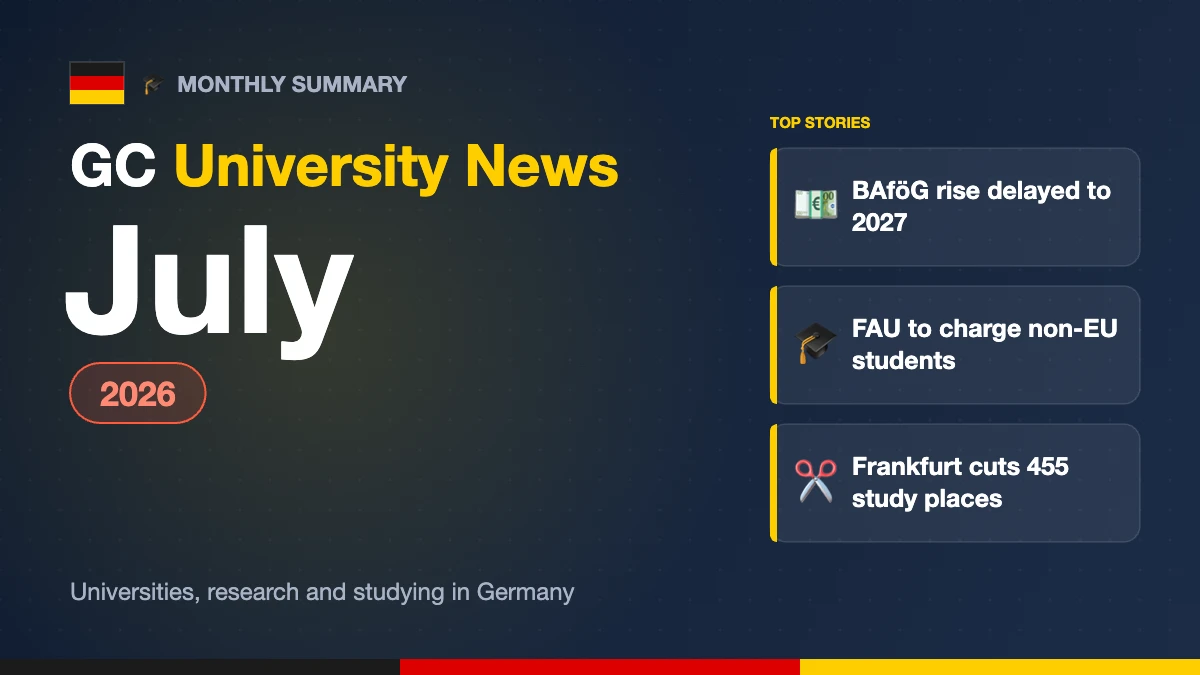
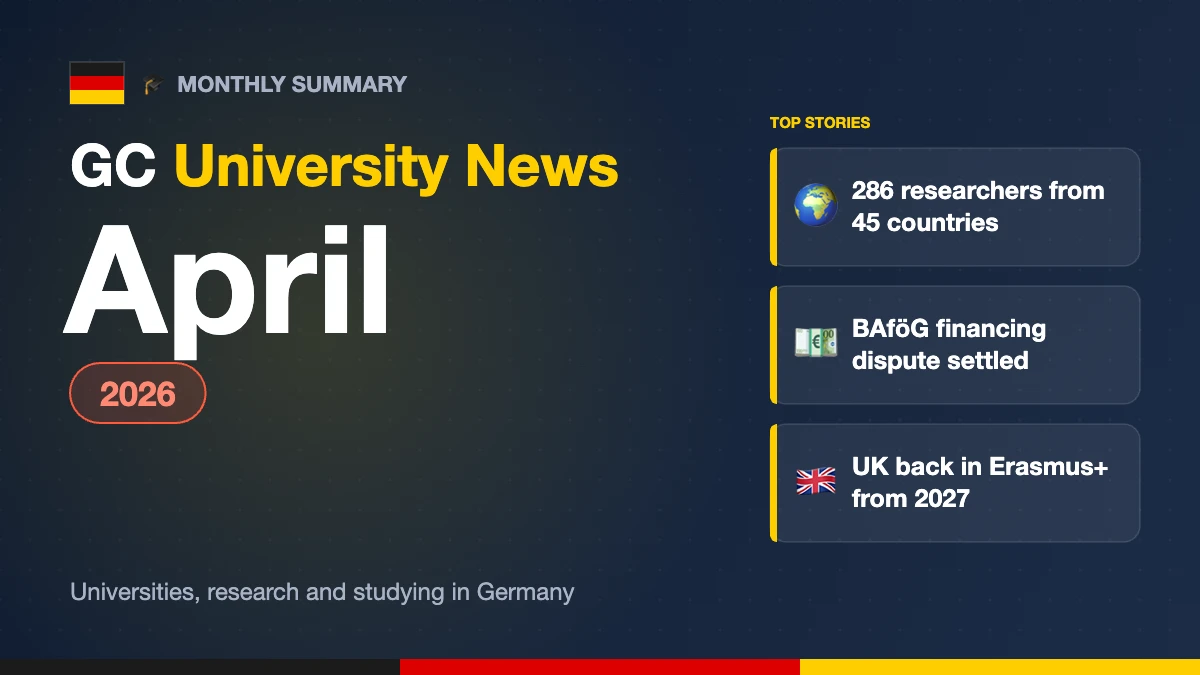
In April, the coalition said it had solved the financing of the BAföG reform. But the reform was not yet law.
In an interview published on 23 May, Union parliamentary leader Jens Spahn said that benefits like BAföG could not be raised for now while the economy is not growing. Student associations and the opposition criticised him sharply, and a week later Research Minister Dorothee Bär also said she no longer expected a quick reform.
Sources: Forschung & Lehre · Forschung & Lehre
🧾 New draft law: longer first contracts for PhD candidates
The WissZeitVG allows universities to give researchers fixed-term contracts for up to six years before and six years after the doctorate. Very short contracts are a major source of stress for PhD candidates and international researchers, whose residence permits often depend on their jobs.
On 29 May, the Research Ministry published a new draft. First contracts should run at least three years before the doctorate and at least two years after. Student assistant contracts could last up to eight years instead of six. Caring for relatives would extend the maximum contract time by two years. Critics called it a “small step” rather than a complete reform.
👉 What it means for you: If the reform passes, a PhD position should start with a contract of at least three years, which also makes your visa planning easier.
Source: Forschung & Lehre
🏅 Seven top researchers move to Germany with Humboldt Professorships
The Alexander von Humboldt Professorship is Germany’s most valuable international research award. It brings leading researchers from abroad to German universities.
On 12 May, seven researchers received the award in Berlin. They move to universities in Berlin, Dresden, Düsseldorf, Freiburg, Göttingen, Karlsruhe and Tübingen, and some return to the university where they once studied. According to Forschung & Lehre, the funding is worth up to €10 million.
Source: Forschung & Lehre
🤖 Germany attracts more AI talent
A study by the think tank interface and the University of Graz compared how countries win and keep artificial intelligence experts.
It found that more AI professionals are moving to Germany, but the share of women among them is falling. The authors say countries need a complete strategy for training, attracting and keeping talent.
👉 What it means for you: AI and data science skills are in demand. If you study in these fields, internships and working student jobs in Germany are a great way into the job market.
Source: Forschung & Lehre
🚀 German universities produce fewer successful start-ups
The Redstone University Startup Index 2026, by AlpMomentum, Redstone, TU Munich and the University of Trier, compared 1,000 European universities.
It found that German universities produce relatively few successful start-ups compared with other European countries, and that universities could create many more jobs through spin-offs.
👉 What it means for you: Many universities have free start-up centres, such as UnternehmerTUM in Munich. If you have a business idea, use them. Some offer coaching in English.
Source: Forschung & Lehre
🌐 UNESCO: universities worldwide face shrinking budgets
UNESCO’s report on global trends in higher education, published in mid-May, found more students worldwide but shrinking budgets per student. New regional study hubs, new funding models and better recognition of foreign qualifications are changing international student mobility.
Source: Forschung & Lehre
🔭 What to watch next
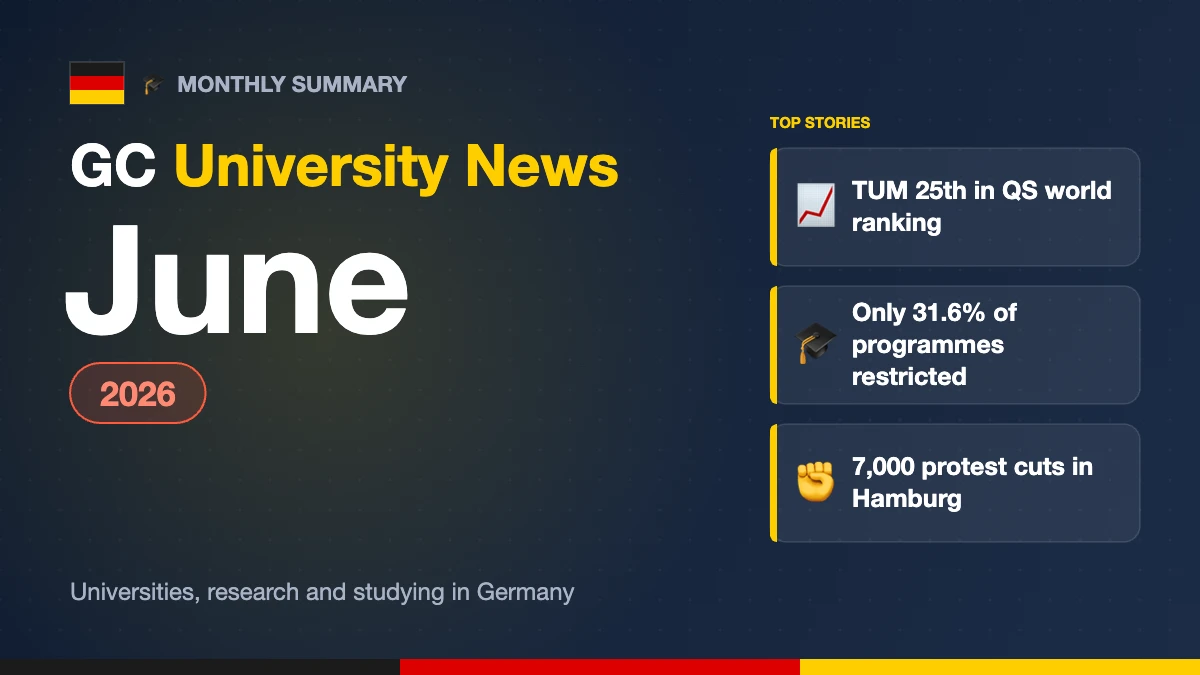
- June: the QS World University Rankings 2027 are published.
- June: the debate about the BAföG reform continues.
- The federal government prepares the cabinet decision on the WissZeitVG reform.
📚 All sources for May 2026
- Forschung & Lehre: Hackers attack the Canvas learning platform
- DAAD: DAAD annual report: about 400,000 international students
- Forschung & Lehre: DAAD fears the end of its partnerships with the Global South
- Forschung & Lehre: Studying in Germany is the fastest route into a German job
- Forschung & Lehre: Baden-Württemberg wants to review tuition fees for international students
- Open letter (BAS, GEW and others): Baden-Württemberg wants to review tuition fees for international students
- Forschung & Lehre: TU Berlin has to close its main building
- Forschung & Lehre: TU Berlin has to close its main building
- Forschung & Lehre: BAföG reform in doubt again
- Forschung & Lehre: BAföG reform in doubt again
- Forschung & Lehre: New draft law: longer first contracts for PhD candidates
- Forschung & Lehre: Seven top researchers move to Germany with Humboldt Professorships
- Forschung & Lehre: Germany attracts more AI talent
- Forschung & Lehre: German universities produce fewer successful start-ups
- Forschung & Lehre: UNESCO: universities worldwide face shrinking budgets
📲 Get short updates every week: follow German Campus on WhatsApp. For everything else happening in Germany, read our weekly German Campus News, browse all GC University News issues, and try our free German course.
Was this guide helpful?
Thank you! Your feedback helps us keep this guide accurate.