
Last updated: By Kumar Ashish, German Campus
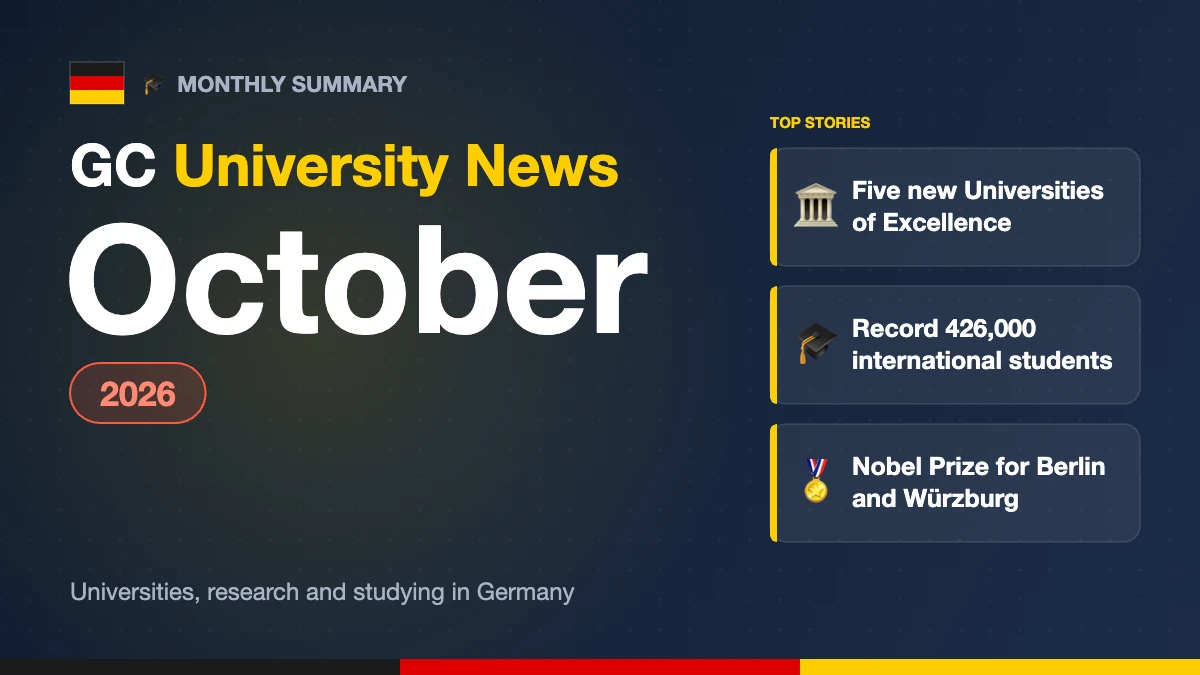
Welcome to GC University News for October 2026, one of the biggest months of the year for German universities. The Excellence Strategy chose five new Universities of Excellence, two researchers in Germany won the Nobel Prize in Medicine, and a new report counted more international students than ever before. At the same time, a wave of cyberattacks hit more universities, and students prepared nationwide protests against education cuts.
📋 In this issue
- 🏛️ Five new Universities of Excellence
- 🎓 Record: about 426,000 international students in Germany
- 🏅 Nobel Prize in Medicine for two researchers in Germany
- 🔐 A wave of cyberattacks: Halle, Baden-Württemberg, Leipzig
- 🎓 More graduates: 527,600 degrees in 2025
- 🇪🇺 EU adds €210 million for PhD and postdoc fellowships
- 🏛️ Freie Universität Berlin may now appoint its own professors
- ✂️ Goethe University Frankfurt plans a major restructuring
- ✊ Students protest against education cuts
- ⚖️ Research institutes may pay more: Academic Freedom Act reform passed
- 🇺🇸 US investigates nine top universities over research visas
- 🎓 Doctorates at universities of applied sciences triple, but remain rare
🏛️ Five new Universities of Excellence
The Universities of Excellence are the top tier of Germany’s Excellence Strategy. In March, ten existing ones kept their title. Eleven applicants (seven universities and four alliances) competed for up to five new places.
On 2 October in Bonn, the Excellence Commission chose the University of Freiburg, the University of Jena and the University of Cologne, plus two alliances: the Ruhr Innovation Lab (Ruhr University Bochum and TU Dortmund) and the Rhine-Main Universities (TU Darmstadt, Goethe University Frankfurt and the University of Mainz). Not selected were the Northwest Alliance of the Universities of Bremen and Oldenburg, the alliance of Gießen and Marburg, Leibniz University Hannover, Hannover Medical School, Kiel University and the University of Würzburg. From 1 January 2027, Germany will have 15 Universities of Excellence, funded 75% by the federal government and 25% by the states, from a pot of €208 million per year for this funding line.
👉 What it means for you: All 15 are strong choices for research-oriented master’s and PhD studies. Universities that were not selected keep their Clusters of Excellence and remain excellent places to study, so do not rule them out.
Source: Forschung & Lehre
🎓 Record: about 426,000 international students in Germany
“Wissenschaft weltoffen” is the annual report of the DAAD and the German Centre for Higher Education Research (DZHW) on international students and researchers in Germany. It is the most reliable source on the topic.
The 2026 edition, published on 14 October, counts about 426,200 international students and doctoral candidates in the winter semester 2025/26, about 6% more than a year earlier and 14.8% of all students. A record of about 130,000 international students started their studies. India is the largest country of origin with about 69,000 students, followed by China with about 39,000. 56% of international degree students study STEM subjects, compared with 33% of German students, and half are in master’s programmes. Between 2022 and 2026, the number of English-taught bachelor programmes grew by 68% and master programmes by 34%. Germany is now the fourth most popular host country worldwide, after the US, the UK and Australia, and the most important non-English-speaking one. The report names language support, practical contacts and career services as key to helping graduates stay.
👉 What it means for you: You are part of a large, growing community, and there are more English-taught programmes than ever. Still, German skills, internships and your university’s career service make the biggest difference when you look for a job after graduation.
Sources: Forschung & Lehre · Education Post
🏅 Nobel Prize in Medicine for two researchers in Germany
The Nobel Prizes are the world’s most famous science awards. Germany has a long Nobel history, but recent decades brought fewer prizes than in the early 20th century.
On 5 October, the Karolinska Institute awarded the Nobel Prize in Physiology or Medicine to Peter Hegemann (Humboldt-Universität zu Berlin) and Georg Nagel (University of Würzburg), together with a US researcher, for pioneering work on optogenetics. The method uses light to switch nerve cells on and off and helps researchers understand how the brain creates memories, emotions and behaviour. Nagel did the key work in 2002 and 2003 at the Max Planck Institute of Biophysics in Frankfurt.
👉 What it means for you: Nobel-level research happens at German public universities with low or no tuition fees. Many of these labs welcome international master’s students and PhD candidates.
Sources: Forschung & Lehre · hessenschau
🔐 A wave of cyberattacks: Halle, Baden-Württemberg, Leipzig
After the attacks on LMU Munich and Bremen in September, more universities were hit in October.
Test your German for freeA1 to C1 in 8 minutes, with your level and a study planStart test →
On 7 October, the university service centre of Baden-Württemberg (HSZ-BW), which handles applications for many universities there, took all systems offline after an attack. On 14 October, Martin Luther University Halle-Wittenberg discovered an attack: the applications of about 51,000 people for the summer semester 2026 and the current winter semester, including uploaded documents, names, addresses and dates of birth, may have been stolen. On 21 October, a security flaw in the programming language PHP forced many websites offline worldwide, including university sites. On 28 October, Leipzig University took all its IT services offline after a cyberattack.
👉 What it means for you: If you applied to Halle or through HSZ-BW, be especially careful with emails about your application, admission or fees. Check information only on the official university website and contact the admissions office directly if in doubt.
Sources: Forschung & Lehre · Forschung & Lehre · Forschung & Lehre
🎓 More graduates: 527,600 degrees in 2025
On 2 October, the Federal Statistical Office reported that about 527,600 students and doctoral candidates earned a degree at a German university in 2025, 3% more than the year before, the second increase in a row. Women made up 53%. Bachelor degrees drove the growth.
Source: Forschung & Lehre
🇪🇺 EU adds €210 million for PhD and postdoc fellowships
The Marie Skłodowska-Curie Actions (MSCA) are the EU’s main programme for doctoral candidates and postdocs, open to researchers of all nationalities.
On 1 October, the European Commission announced more than €210 million extra for MSCA Postdoctoral Fellowships and Doctoral Networks in 2026 and 2027, funding about 700 additional researchers as part of its “Choose Europe” initiative.
👉 What it means for you: If you are finishing a master’s or PhD, look for MSCA Doctoral Network positions and Postdoctoral Fellowships hosted by German universities. They pay well and are fully international.
Source: Forschung & Lehre
🏛️ Freie Universität Berlin may now appoint its own professors
In most German states, the state ministry formally appoints professors. Some states give universities this right as a sign of autonomy.
On 8 October, Berlin’s science senator transferred the right of appointment to Freie Universität Berlin, the first Berlin university to receive it, initially for four years. FU president Günter Ziegler called it a milestone for university autonomy.
Source: Forschung & Lehre
✂️ Goethe University Frankfurt plans a major restructuring
Hesse’s budget pressure continues to shape Frankfurt’s university.
According to reports in the Frankfurter Allgemeine Zeitung and the Frankfurter Rundschau, the university’s leadership presented a strategy draft for 2031 and beyond that would significantly reduce the number of faculties and cut many professorships.
👉 What it means for you: If you study or plan to study in Frankfurt, follow announcements about your faculty, because programmes may be merged or reorganised in the coming years.
Source: Forschung & Lehre
✊ Students protest against education cuts
Across Germany, students and young people have protested against cuts in education and other issues. A nationwide day of protest was called for 31 October.
On 28 October, students blocked the Otto Suhr Institute at Freie Universität Berlin, with similar actions in other cities. FU said it respects the right to peaceful protest.
👉 What it means for you: Peaceful protest is your right in Germany. If you take part, stay with the registered demonstration and avoid anything that could get you into legal trouble, as this can affect your residence permit.
Source: Forschung & Lehre
⚖️ Research institutes may pay more: Academic Freedom Act reform passed
The Bundestag passed the reform of the Wissenschaftsfreiheitsgesetz on 24 September, and the Bundesrat approved it on 16 October. Non-profit research institutions funded through projects may now pay staff more than federal employees when third-party funds cover the cost, and EU funds can be used for salaries. Four more institutions, including the DZHW, now fall under the law.
Source: Forschung & Lehre
🇺🇸 US investigates nine top universities over research visas
On 8 October, US authorities announced an investigation of nine universities, including Harvard, Yale, Stanford, MIT and Caltech, over suspected fraud in J-1 visa programmes for international researchers. The universities say they follow visa law.
👉 What it means for you: Pressure on international researchers in the US continues, while Germany is actively recruiting them. This is one reason German universities report more applications from abroad.
Source: Forschung & Lehre
🎓 Doctorates at universities of applied sciences triple, but remain rare
Traditionally, only universities could award doctorates. Several states now allow strong research areas at universities of applied sciences (HAW) to do so too.
A CHE analysis published at the end of October found that the number of doctoral candidates directly at HAWs has more than tripled since 2023, but they still make up less than 1% of all doctorates. Bavaria accounts for almost a third.
Source: Forschung & Lehre
🔭 What to watch next
- November: the Bundestag continues work on the BAföG and WissZeitVG reforms.
- November: federal budget decisions for science and the DAAD.
- December: the Leibniz Prizes 2027 are announced.
📚 All sources for October 2026
- Forschung & Lehre: Five new Universities of Excellence
- Forschung & Lehre: Record: about 426,000 international students in Germany
- Education Post: Record: about 426,000 international students in Germany
- Forschung & Lehre: Nobel Prize in Medicine for two researchers in Germany
- hessenschau: Nobel Prize in Medicine for two researchers in Germany
- Forschung & Lehre: A wave of cyberattacks: Halle, Baden-Württemberg, Leipzig
- Forschung & Lehre: A wave of cyberattacks: Halle, Baden-Württemberg, Leipzig
- Forschung & Lehre: A wave of cyberattacks: Halle, Baden-Württemberg, Leipzig
- Forschung & Lehre: More graduates: 527,600 degrees in 2025
- Forschung & Lehre: EU adds €210 million for PhD and postdoc fellowships
- Forschung & Lehre: Freie Universität Berlin may now appoint its own professors
- Forschung & Lehre: Goethe University Frankfurt plans a major restructuring
- Forschung & Lehre: Students protest against education cuts
- Forschung & Lehre: Research institutes may pay more: Academic Freedom Act reform passed
- Forschung & Lehre: US investigates nine top universities over research visas
- Forschung & Lehre: Doctorates at universities of applied sciences triple, but remain rare
📲 Get short updates every week: follow German Campus on WhatsApp. For everything else happening in Germany, read our weekly German Campus News, browse all GC University News issues, and try our free German course.
Was this guide helpful?
Thank you! Your feedback helps us keep this guide accurate.