Last updated: By Kumar Ashish, German Campus
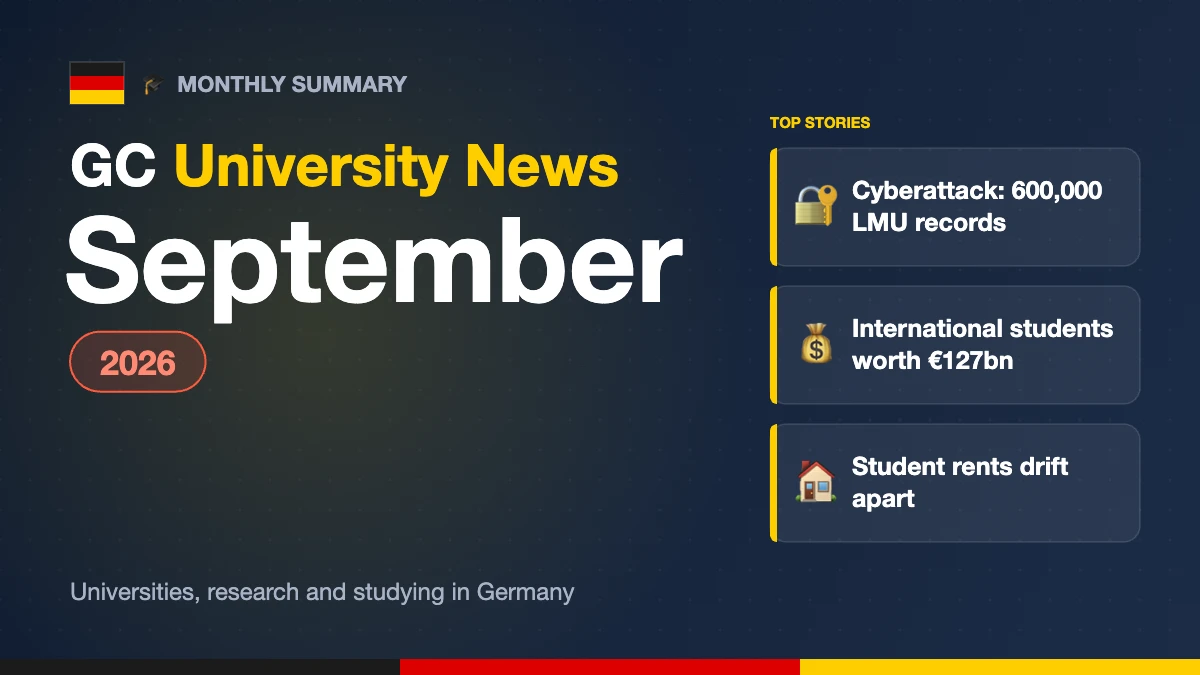
Welcome to GC University News for September 2026. As thousands of new international students arrived for the winter semester, hackers hit LMU Munich and the University of Bremen. A major study calculated how much international students contribute to Germany, a housing study showed growing gaps between cheap and expensive university towns, and the states demanded a faster BAföG increase. Plus: rankings, research funding and visa refusals for Chinese researchers.
📋 In this issue
- 🔐 Cyberattack on LMU Munich: up to 600,000 records affected
- 🔐 University of Bremen hit by a zero-day attack
- 💰 International students are worth €127 billion to Germany
- 🏠 Student rents: cheap and expensive cities drift apart
- 💶 Bundesrat wants the BAföG increase sooner
- 📈 THE World University Rankings 2027: TUM 25th
- 🏆 Shanghai subject ranking: two German universities in a world top 10
- 🇨🇳 Germany rejects many more visas for Chinese researchers
- 🇪🇺 89 ERC Starting Grants for researchers in Germany
- 🌍 DFG funds 15 new professorships for international top researchers
- 🏗️ Hesse stretches its university building programme to 2036
- 💻 Universities want to prepare students for a digital working world
- 📉 Research funding per professor falls for the first time since 2016
- 📚 OECD: Germany leads in STEM degrees
🔐 Cyberattack on LMU Munich: up to 600,000 records affected
Universities hold large amounts of personal data, from passport copies to bank details, which makes them attractive targets for criminal hackers.
On 16 September, attackers got into LMU Munich’s admissions system. LMU first said it must assume student master data was accessed: names, postal and email addresses, dates and places of birth and bank details, possibly also health insurance and BAföG numbers. Exam results and course content were not affected. On 28 September, LMU said that the whole admissions system was affected, including enrolment data from the past 50 years, about 600,000 records, though older records contain less data. The Bavarian State Criminal Police Office (LKA) is investigating. New enrolments were temporarily unavailable and deadlines were extended.
👉 What it means for you: If you study or studied at any German university, watch your bank account and never click links or open attachments in unexpected emails or text messages, even if they use your real data. Universities never ask for your password by email.
Sources: Forschung & Lehre · Forschung & Lehre
🔐 University of Bremen hit by a zero-day attack
A “zero-day attack” uses a security gap that the software maker does not yet know about, so no update exists yet.
On 22 September, the University of Bremen reported such an attack on decentralised facilities. The systems were taken offline immediately and the gap was closed. According to the university, the damage was minor, central services kept working and no student data was leaked. The university sees the attack as part of an international wave.
Source: Universität Bremen
💰 International students are worth €127 billion to Germany
Some politicians argue that educating international students for free costs Germany too much. A new study looked at the actual numbers.
On 8 September, the DAAD presented a study by the German Economic Institute (IW). For the roughly 82,000 international students who started in 2023, it calculated a value creation of about €127 billion over their working lives and a surplus of €23.1 billion for public budgets. Nine years after starting, 59% are still in Germany, about 45% are available to the labour market as graduates, and about a third of them spend their entire working life here. Already two years after graduating, they pay more into the system than Germany invested in them. The IW recommends expanding tuition-free education for international students.
👉 What it means for you: This is a strong argument against tuition fees and for better support for international students. Your degree and work here benefit Germany, not only you.
Source: Forschung & Lehre
🏠 Student rents: cheap and expensive cities drift apart
Rent is the biggest cost for most students in Germany. The Moses Mendelssohn Institute studies student housing costs in the 90 German university towns with more than 5,000 students every year, using data from the platform WG-Gesucht.
Its September study found that only 20.7% of students are enrolled in towns with mid-range rents for the winter semester 2026/27, compared with 35.4% ten years ago. The gap between cheap and expensive towns has grown by about 27%. As the institute’s director put it, whether a shared-flat room costs €400, €500 or €650 can decide which study town you can afford at all.
👉 What it means for you: When choosing a university, compare rents, not just rankings. Cities like Chemnitz, Magdeburg or Halle are much cheaper than Munich, Frankfurt or Hamburg. Apply early for a dorm room with your local Studierendenwerk.
Source: Forschung & Lehre
Test your German for freeA1 to C1 in 8 minutes, with your level and a study planStart test →
💶 Bundesrat wants the BAföG increase sooner
Laws like the BAföG reform need the Bundesrat, where the 16 federal states are represented, to comment and often to agree.
On 25 September, the Bundesrat called the reform insufficient. It wants the higher rates and housing allowance to start in the winter semester 2026/27 instead of summer 2027, wants to keep the housing allowance for students living with their parents, and asks for fully digital applications that automatically use data authorities already hold. On the research contract law, it asked that contracts shorter than the legal minimum count as fixed-term, not open-ended.
👉 What it means for you: The Bundestag still has to vote, so details can change. We will report when the final rules are clear.
Source: Forschung & Lehre
📈 THE World University Rankings 2027: TUM 25th
The Times Higher Education (THE) ranking weighs teaching, research environment, research quality, industry links and international outlook.
In the 2027 edition, published at the end of September, TU Munich ranked 25th in the world. TUM is now in the top 25 of both THE and QS and the best university in the EU in both. In THE subject tables, TUM is 15th in computer science and 19th in both physical sciences and engineering.
Source: TUM
🏆 Shanghai subject ranking: two German universities in a world top 10
On 15 September, the Shanghai Ranking published its Global Ranking of Academic Subjects 2026. US universities took first place 27 times. TU Munich and LMU Munich reached the world top 10 in two subjects, agricultural sciences and communication.
Source: Forschung & Lehre
🇨🇳 Germany rejects many more visas for Chinese researchers
German security agencies have long warned about science espionage, especially in technologies with military uses.
A joint investigation by WDR, NDR and Süddeutsche Zeitung, published on 10 September, showed for the first time that Germany now rejects hundreds of visa applications from Chinese researchers and students every year.
👉 What it means for you: If you are from China, choose your field and supervisor carefully, prepare complete documents and expect longer security checks for sensitive subjects.
Source: Forschung & Lehre
🇪🇺 89 ERC Starting Grants for researchers in Germany
The European Research Council (ERC) Starting Grant is one of Europe’s most prestigious awards for early-career researchers, worth up to €1.5 million.
On 3 September, the ERC announced €705 million for 421 researchers. Only 8.8% of 4,807 applicants were successful. 89 grants went to institutions in Germany.
👉 What it means for you: If you aim for an academic career, an ERC grant can launch your own research group in Germany, regardless of your nationality.
Source: Forschung & Lehre
🌍 DFG funds 15 new professorships for international top researchers
As part of the government’s “1000 Köpfe Plus” programme, the DFG funds professorships and fellowships in Clusters of Excellence and Collaborative Research Centres.
On 17 September, the DFG approved 15 professorships and 12 Mercator Fellows at 18 locations.
Source: Forschung & Lehre
🏗️ Hesse stretches its university building programme to 2036
Hesse’s “Heureka” programme pays for university construction and renovation.
In August, the state said €1.4 billion planned for 2027 to 2031 will now be spread until 2036. The opposition put the construction and renovation backlog at Hessian universities at least €2.69 billion. The university presidents were disappointed.
Source: Forschung & Lehre
💻 Universities want to prepare students for a digital working world
The Hochschulforum Digitalisierung asked 120 university vice-presidents about their digital strategies. 95% said preparing students for a working world shaped by AI and digital technology is an important strategic goal. AI has given digital teaching new momentum.
Source: Forschung & Lehre
📉 Research funding per professor falls for the first time since 2016
Third-party funding (Drittmittel) is research money that professors win from the DFG, the EU, foundations or companies.
In 2024, a university professor raised on average €325,400, 2.1% less than in 2023, according to the Federal Statistical Office on 28 September. It is the first drop since 2016.
Source: Forschung & Lehre
📚 OECD: Germany leads in STEM degrees
On 29 September, the OECD published “Education at a Glance 2026”. Germany is at the top among OECD countries for the share of degrees in mathematics, computer science, natural sciences and engineering (MINT).
Source: Forschung & Lehre
🔭 What to watch next
- 2 October: decision on the new Universities of Excellence.
- From 5 October: Nobel Prize announcements.
- 14 October: new figures on international students (Wissenschaft weltoffen).
📚 All sources for September 2026
- Forschung & Lehre: Cyberattack on LMU Munich: up to 600,000 records affected
- Forschung & Lehre: Cyberattack on LMU Munich: up to 600,000 records affected
- Universität Bremen: University of Bremen hit by a zero-day attack
- Forschung & Lehre: International students are worth €127 billion to Germany
- Forschung & Lehre: Student rents: cheap and expensive cities drift apart
- Forschung & Lehre: Bundesrat wants the BAföG increase sooner
- TUM: THE World University Rankings 2027: TUM 25th
- Forschung & Lehre: Shanghai subject ranking: two German universities in a world top 10
- Forschung & Lehre: Germany rejects many more visas for Chinese researchers
- Forschung & Lehre: 89 ERC Starting Grants for researchers in Germany
- Forschung & Lehre: DFG funds 15 new professorships for international top researchers
- Forschung & Lehre: Hesse stretches its university building programme to 2036
- Forschung & Lehre: Universities want to prepare students for a digital working world
- Forschung & Lehre: Research funding per professor falls for the first time since 2016
- Forschung & Lehre: OECD: Germany leads in STEM degrees
📲 Get short updates every week: follow German Campus on WhatsApp. For everything else happening in Germany, read our weekly German Campus News, browse all GC University News issues, and try our free German course.
Was this guide helpful?
Thank you! Your feedback helps us keep this guide accurate.