
Last updated: By Kumar Ashish, German Campus
Here is GC University News for June 2026. A new world ranking put TU Munich in the top 25, a study showed that it has never been easier to get into your preferred programme, and the fight over BAföG continued in parliament. Thousands of students and staff protested cuts in Hamburg, Berlin’s student assistants won a pay rise, and German universities worried about EU research money.
📋 In this issue
- 📈 QS World University Rankings 2027: TUM is 25th
- 🎓 The numerus clausus is losing importance
- 💶 BAföG: the fight continues in parliament
- 💶 Berlin: new pay deal for student assistants
- ✊ 7,000 people protest cuts at Hamburg universities
- 🌍 Universities appeal to save DAAD partnerships with the Global South
- ✊ Student groups call for an end to tuition fees in Baden-Württemberg
- 🇪🇺 One million German students have done Erasmus
- 📚 National education report: better advice could reduce inequality
- 🏛️ Bavaria plans new university rules on AI, discipline and construction
- 🇪🇺 HRK criticises planned EU cuts to research
- 📉 Germany postpones its R&D spending target to 2030
📈 QS World University Rankings 2027: TUM is 25th
The QS World University Rankings are among the three most-watched global rankings, together with Times Higher Education (THE) and Shanghai (ARWU). QS puts strong weight on academic reputation, employer reputation and international diversity.
On 18 June, QS published its 2027 edition. TU Munich ranked 25th in the world, the best university in the European Union and number 1 in Germany for the twelfth time in a row.
👉 What it means for you: Rankings are one signal among many. For your application, the programme’s content, language, the city, living costs and job prospects usually matter more than a university’s overall rank.
Source: TUM
🎓 The numerus clausus is losing importance
A “numerus clausus” (NC) means that a programme has more applicants than places, so admission depends on your grades or a selection procedure. Programmes without restrictions (zulassungsfrei) admit everyone who meets the formal requirements.
The CHE Centre for Higher Education found that only 31.6% of all programmes have admission restrictions for the coming winter semester, down from 32.5% last year and 47.6% ten years ago. In bachelor programmes, it is just 28.7%. Even in medicine, the ratio has improved to about three applicants per place at public universities. CHE says the chances of getting into your preferred programme have probably never been better.
👉 What it means for you: Many programmes are open to everyone who meets the requirements. Restrictions for international applicants (language level, recognised school certificate) still apply, so read each programme’s admission rules carefully.
Source: Forschung & Lehre
💶 BAföG: the fight continues in parliament
The BAföG reform was promised for the winter semester 2026/27, but in late May leading coalition politicians questioned whether it would come at all.
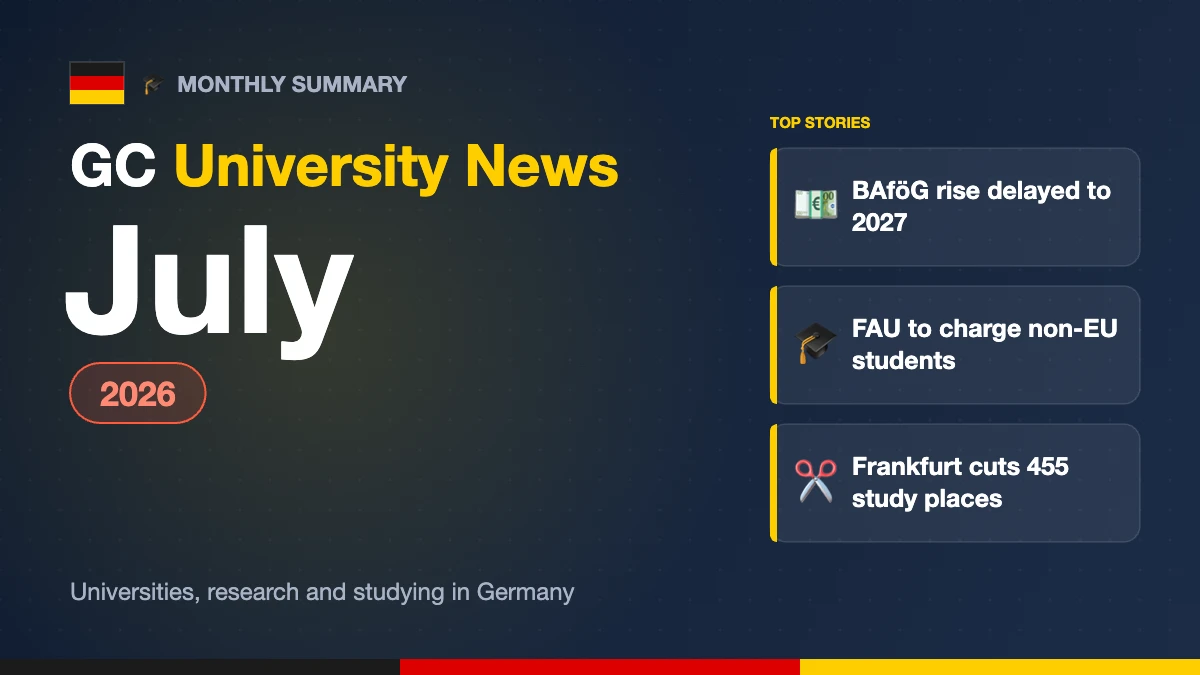
On 11 June, the Bundestag rejected two Green motions for a broad BAföG reform, with votes from CDU/CSU, SPD and AfD, while SPD politicians promised that an increase would come. On 30 June, the state science ministers, meeting in Lindau, demanded that the federal government finally bring the reform forward. A coalition deal followed in July.
👉 What it means for you: Do not plan your budget with higher BAföG rates until the law is passed.
Sources: Forschung & Lehre · Forschung & Lehre · Forschung & Lehre
💶 Berlin: new pay deal for student assistants
Berlin is the only German state with its own collective agreement for student assistants (TV Stud), won after long strikes.
Test your German for freeA1 to C1 in 8 minutes, with your level and a study planStart test →
On 29 June, unions and Berlin’s universities agreed on TV Stud III. The hourly wage rises from €14.32 to €15.08, backdated to 1 January 2026, then to €15.90 in January 2027 and €16.06 in January 2028. After that, pay follows the public sector agreements of the states.
👉 What it means for you: If you work as a HiWi in Berlin, you get back pay for the months since January.
Source: HWR Berlin
✊ 7,000 people protest cuts at Hamburg universities
Hamburg’s state budget is under pressure, and its universities expect cuts in the 2027/2028 double budget.
On 11 June, about 7,000 students and staff of the University of Hamburg marched from the main building to the city hall under the motto “Wissen Schafft Zukunft” (Knowledge Creates Future). They fear fewer study places, cuts to teaching and the loss of up to 370 full-time positions, even though the university just kept its excellence title.
Source: Forschung & Lehre
🌍 Universities appeal to save DAAD partnerships with the Global South
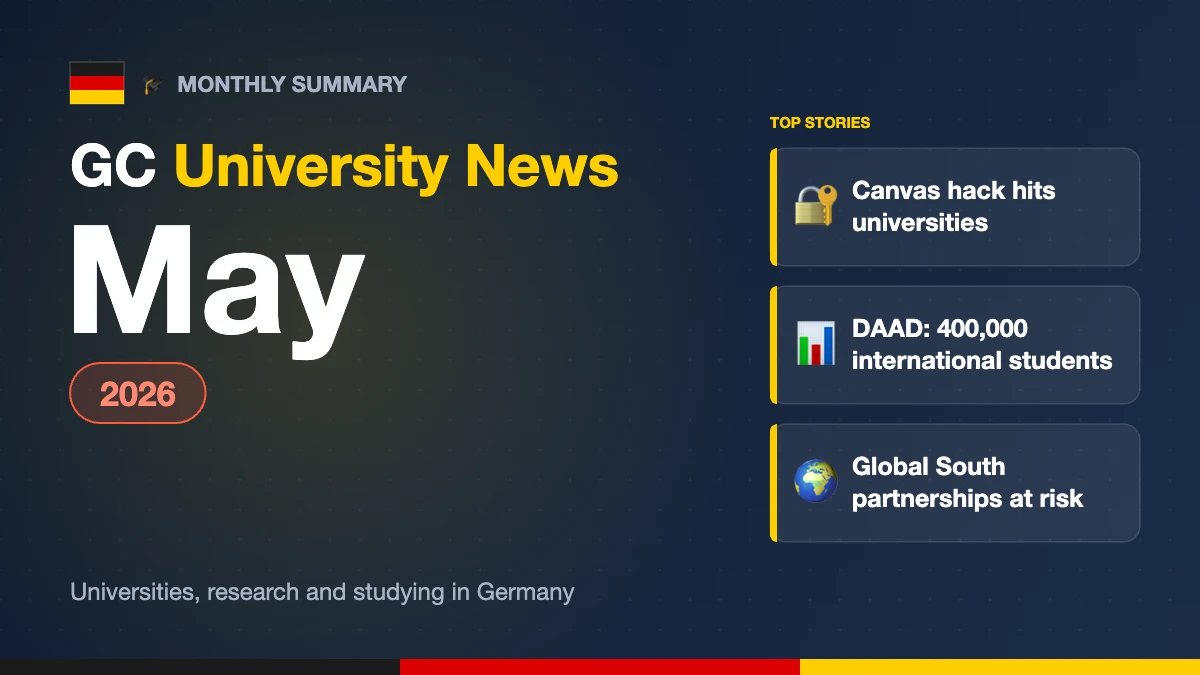
In May, the DAAD warned that the Development Ministry (BMZ) plans to end almost all of its university cooperation programmes with the Global South by 2031.
On 22 June, Hesse’s universities, universities of applied sciences and art academies made a joint appeal to the federal government. In the past five years, these programmes reached almost 120,000 people in about 60 countries and connected about 450 partner institutions, on topics like energy, water, health and digitalisation. Hesse alone had 44 projects. On 1 July, the Alliance of Science Organisations, Germany’s most important research bodies, also criticised the plan.
👉 What it means for you: If you come from one of these regions, use partnership programmes and related scholarships while they still exist.
Sources: Philipps-Universität Marburg · Forschung & Lehre
✊ Student groups call for an end to tuition fees in Baden-Württemberg
After the new coalition in Baden-Württemberg only promised to “review” tuition fees for international students, student and union groups went further.
In an open letter, the Federal Association of International Students (BAS), the education union GEW, the state student representation and other groups demanded the abolition of the €1,500 fee for non-EU students and the €650 fee for second degrees, plus more money for language courses, support services and an emergency fund for international students in financial hardship.
Source: Open letter (BAS, GEW and others)
🇪🇺 One million German students have done Erasmus
Since 1987, Erasmus (now Erasmus+) has allowed students to spend a semester or internship in another European country.
In June, the DAAD’s National Agency for Erasmus+ announced that one million students from German universities have now taken part. DAAD president Joybrato Mukherjee called it a strong sign of the programme’s power.
👉 What it means for you: Erasmus+ is open to you as an international student enrolled in Germany. A semester abroad comes with a monthly grant and is a strong point on your CV.
Source: Forschung & Lehre
📚 National education report: better advice could reduce inequality
“Bildung in Deutschland” is the official national education report, published every two years and co-written by the DZHW.
The 2026 edition, published on 15 June, focused on inequality. Social background still strongly affects whether young people study. At the transition from school to university, costs and expected success matter more than actual performance, especially in less privileged families. Better information and advice could help.
Source: Forschung & Lehre
🏛️ Bavaria plans new university rules on AI, discipline and construction
On 23 June, Bavaria’s cabinet discussed changes to its university law. AI at universities should not be generally banned, universities should get a catalogue of sanctions against misconduct such as antisemitism, and a building offensive should speed up repairs and new construction.
Source: Forschung & Lehre
🇪🇺 HRK criticises planned EU cuts to research
EU leaders started negotiating the EU budget for 2028 to 2034 on 18 June. The HRK criticised plans to save on research and development as “the wrong signal” at a time when Europe needs innovation and technological sovereignty.
Source: Forschung & Lehre
📉 Germany postpones its R&D spending target to 2030
Germany had aimed to spend 3.5% of its economic output on research and development by 2025. The government’s 2026 research report admits this target is out of reach and moves it to 2030. R&D spending reached a record €137.1 billion in 2024, but Germany is losing momentum internationally.
Source: Forschung & Lehre
🔭 What to watch next
- July: the coalition negotiates the BAföG reform.
- July: Bavarian universities discuss tuition fees for non-EU students.
- The federal cabinet is expected to adopt the WissZeitVG reform.
📚 All sources for June 2026
- TUM: QS World University Rankings 2027: TUM is 25th
- Forschung & Lehre: The numerus clausus is losing importance
- Forschung & Lehre: BAföG: the fight continues in parliament
- Forschung & Lehre: BAföG: the fight continues in parliament
- Forschung & Lehre: BAföG: the fight continues in parliament
- HWR Berlin: Berlin: new pay deal for student assistants
- Forschung & Lehre: 7,000 people protest cuts at Hamburg universities
- Philipps-Universität Marburg: Universities appeal to save DAAD partnerships with the Global South
- Forschung & Lehre: Universities appeal to save DAAD partnerships with the Global South
- Open letter (BAS, GEW and others): Student groups call for an end to tuition fees in Baden-Württemberg
- Forschung & Lehre: One million German students have done Erasmus
- Forschung & Lehre: National education report: better advice could reduce inequality
- Forschung & Lehre: Bavaria plans new university rules on AI, discipline and construction
- Forschung & Lehre: HRK criticises planned EU cuts to research
- Forschung & Lehre: Germany postpones its R&D spending target to 2030
📲 Get short updates every week: follow German Campus on WhatsApp. For everything else happening in Germany, read our weekly German Campus News, browse all GC University News issues, and try our free German course.
Was this guide helpful?
Thank you! Your feedback helps us keep this guide accurate.