
Last updated: By Kumar Ashish, German Campus
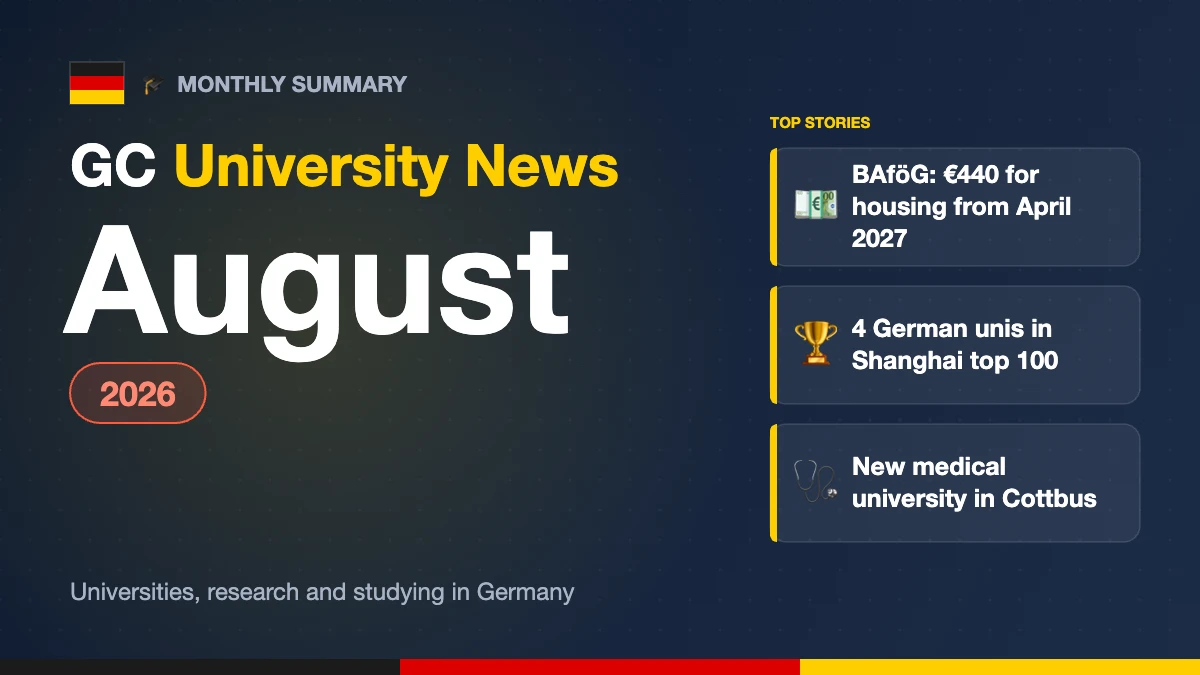
Here is GC University News for August 2026. While many students enjoyed the semester break, the federal cabinet adopted the BAföG reform, new statistics showed fewer students than ever receiving BAföG, and the Shanghai ranking put four German universities in the world top 100. A brand new medical university prepared to open, and states argued about university budgets for the coming years.
📋 In this issue
- 💶 Cabinet adopts the BAföG reform
- 📉 Fewer students than ever receive BAföG
- 🏆 Shanghai ranking: four German universities in the top 100
- 🩺 A new medical university opens in Cottbus
- ✂️ Hamburg universities warn about deep cuts
- 💰 Thuringia gives its universities €3.1 billion
- 🎓 A record 216,243 doctoral candidates
- 🤖 Bayreuth founds a research centre for responsible AI
- 🇺🇸 Germany courts American researchers
- 🔬 Experts: Germany is falling behind in technology
- 👩🎓 Women are ahead in education
- 🇨🇳 TUM criticised over research contacts with China
💶 Cabinet adopts the BAföG reform
After months of political back and forth, the reform of student finance (BAföG) reached the next stage: the federal cabinet adopts a draft, which then goes to the Bundestag and Bundesrat for approval.
On 12 August, the cabinet adopted the reform. The housing allowance rises from €380 to €440 per month from 1 April 2027. The basic amount rises to €503 from the winter semester 2027/28 and to €563 from the summer semester 2029. Income allowances will rise by 1.5% every year, and applications move online to “BAföG digital”. Students will no longer need to prove academic performance after the fourth semester. The age limit of 45 stays, and students who live with their parents lose the housing allowance. Critics point out that an average room in a shared flat costs about €512, more than the new €440.
👉 What it means for you: If you may be eligible, apply, even if you are unsure. Many students who qualify never apply. The online process should make it easier.
Source: Forschung & Lehre
📉 Fewer students than ever receive BAföG
BAföG was designed to make studying possible regardless of family income. But the number of recipients has fallen for years, mainly because income limits for parents rose more slowly than wages.
On 5 August, the Federal Statistical Office reported that 570,000 people received BAföG in 2025, 7% fewer than in 2024 and the lowest number since 2000. Among students, the number fell by 8% to 443,100. Those who received BAföG got on average €682 per month, €25 more than the year before. 33,700 students used the new “flexibility semester”, which allows one extra semester of support. The €1,000 “study start grant” is available to students under 25 from families receiving certain social benefits.
Source: Forschung & Lehre
🏆 Shanghai ranking: four German universities in the top 100
The Academic Ranking of World Universities (ARWU), known as the Shanghai ranking, focuses almost entirely on research: Nobel Prizes, highly cited researchers and publications in top journals.
In the 2026 edition, published on 15 August, TU Munich placed 45th (unchanged), LMU Munich 49th (down from 42nd), Heidelberg 59th (down from 51st) and Bonn 69th (down from 68th). Seven more German universities, including Freiburg, TU Dresden, Frankfurt, Cologne, Göttingen, Münster and Tübingen, ranked between 100 and 200.
👉 What it means for you: The Shanghai ranking mainly measures research output. It says little about teaching quality or student support.
Source: Forschung & Lehre
🩺 A new medical university opens in Cottbus
Germany has a shortage of doctors, especially in rural areas and in eastern Germany. Lusatia (Lausitz), a former coal mining region in Brandenburg, is changing its economy with federal support.
Test your German for freeA1 to C1 in 8 minutes, with your level and a study planStart test →
On 3 August, Brandenburg announced that the new Medical University Lausitz Carl Thiem in Cottbus will open in the winter semester 2026/27 with a model programme in human medicine. It starts with 36 students and should grow to 165 first-year students per year by 2035.
👉 What it means for you: Medicine in Germany is taught in German and is highly competitive. New universities add places, but for non-EU applicants admission usually goes through a separate quota with strong German skills required.
Source: Forschung & Lehre
✂️ Hamburg universities warn about deep cuts
Hamburg’s government is preparing its double budget for 2027 and 2028 and must save money.
On 31 August, Hamburg’s nine state universities warned that the plans could endanger teaching, research and planning security. HafenCity University (HCU) faces a cut of almost 50% to its budget in 2028, which would cost a fifth of its positions and some programmes. The state audit office estimates the city’s savings need at €1 billion. The budget is due to be passed in mid-December.
👉 What it means for you: If you plan to apply to HCU or other Hamburg universities for 2027, check programme pages for changes before applying.
Source: Forschung & Lehre
💰 Thuringia gives its universities €3.1 billion
German states sign long-term funding agreements with their universities so they can plan staff and programmes.
On 18 August, Thuringia’s cabinet approved a new framework agreement for its ten state universities for 2027 to 2034, with about €3.1 billion over the first five years and about €35 million for cooperation between universities. Universities later warned that the money might not be enough.
👉 What it means for you: Universities in Jena, Erfurt, Ilmenau and Weimar get planning security, which is good if you study there.
Source: Forschung & Lehre
🎓 A record 216,243 doctoral candidates
The Federal Statistical Office reported on 26 August that the number of doctoral candidates in Germany rose by 1.8% in 2025 to 216,243. 35,808 people started a doctorate. Women made up 49%. Doctoral candidates were on average about 30 years old.
👉 What it means for you: A PhD in Germany is often a paid job at a university or research institute. International candidates are welcome, and many programmes are in English.
Source: Forschung & Lehre
🤖 Bayreuth founds a research centre for responsible AI
On 4 August, the University of Bayreuth founded the “AI Responsibility Centre”. It will research AI that is robust, transparent, fair and accountable, with topics from human oversight of AI systems to human-AI collaboration.
Source: Forschung & Lehre
🇺🇸 Germany courts American researchers
With US research budgets cut, Germany is actively recruiting researchers from the US. GAIN, the German Academic International Network, holds an annual conference in North America for German researchers working there.
In August, a delegation of state science ministers travelled to the US, joined a German-American roundtable of the DFG in Washington on 19 August and visited the GAIN conference.
Sources: Forschung & Lehre · BMFTR
🔬 Experts: Germany is falling behind in technology
On its 20th anniversary on 20 August, the Expert Commission for Research and Innovation (EFI) warned that Germany is technologically behind and called on the whole government to work with top priority to make the country fit for the future.
Source: Forschung & Lehre
👩🎓 Women are ahead in education
The Federal Statistical Office reported on 20 August that 55% of the 258,300 school leavers with the general university entrance qualification (Abitur) in 2024 were women. Women also finish their degrees faster.
Source: Forschung & Lehre
🇨🇳 TUM criticised over research contacts with China
Research security is a growing concern for German universities working with China, especially in technologies that can be used for civil and military purposes (“dual use”).
In July, the newspaper Handelsblatt criticised TU Munich’s participation in an aerospace conference in Hong Kong. TUM rejected the accusation that it risked a dangerous outflow of knowledge as unfounded.
Source: Forschung & Lehre
🔭 What to watch next
- September: the winter semester application and enrolment period peaks.
- The Bundesrat comments on the BAföG and WissZeitVG reforms.
- End of September: the THE World University Rankings 2027 are published.
📚 All sources for August 2026
- Forschung & Lehre: Cabinet adopts the BAföG reform
- Forschung & Lehre: Fewer students than ever receive BAföG
- Forschung & Lehre: Shanghai ranking: four German universities in the top 100
- Forschung & Lehre: A new medical university opens in Cottbus
- Forschung & Lehre: Hamburg universities warn about deep cuts
- Forschung & Lehre: Thuringia gives its universities €3.1 billion
- Forschung & Lehre: A record 216,243 doctoral candidates
- Forschung & Lehre: Bayreuth founds a research centre for responsible AI
- Forschung & Lehre: Germany courts American researchers
- BMFTR: Germany courts American researchers
- Forschung & Lehre: Experts: Germany is falling behind in technology
- Forschung & Lehre: Women are ahead in education
- Forschung & Lehre: TUM criticised over research contacts with China
📲 Get short updates every week: follow German Campus on WhatsApp. For everything else happening in Germany, read our weekly German Campus News, browse all GC University News issues, and try our free German course.
Was this guide helpful?
Thank you! Your feedback helps us keep this guide accurate.